When ever I enter a city for the first time, I tend to take in up as much as possible during the first few days when everything seems new and unfamiliar. In case I get to stay in that particular city for longer some of these images will start becoming more familiar. Thereby giving me an opportunity, when I have no better things to do, to juxtapose the image of what has now become a familiar site to that of my early images. By doing so I tend to get the same kind of avuncular feeling that is not too different from the feelings I have when I see a young relative whom I last remember was a tiny little fellow.
Few of the early such stored-images I have are that of Pune. I did not travel much before that. I was there for a short stopover in 1987 and was kind of enamoured by the range of stuff that was available – food and otherwise – on the station road. Coming from Vizag, which has nothing in front of the station, this road was far more exciting and we did not do much in the few hours that we had in that city other than hang near the station. Year later when I got to spend three and half years there, even though the station road was the worst road that there is in that city, I did stop to eat or to purchase something on that station road but that was only to revoke those first few memories I had of that place; especially, eating at Sri Krishna restaurant, one of the many below average joints that are found close to many stations.
Similarly when I went back to Flensburg, a small city on the Baltic Sea in Germany last year after many years I was kind of sad looking at the bus stop, which has in the mean time has become swankier. In 1995, when I first went to that city, which incidentally was my first trip abroad, the toughest part of the whole journey from my home in Visakhapatnam was getting to the university from this bus stop.
What had happened was that in the excitement of finally going abroad, I forgot the instruction leaflet that explained how to get to the university from Hamburg airport. (Actually I even forgot my original fellowship letter but that I came to know much after this incident.) It was only after I reached Hamburg that I realized I did not have the instruction sheet but years of such faux pas made me prepare for such situations. I went to the airport help desk and asked them directions to go to Flensburg. I had to hop skip and jump few buses and a train to finally get to Flensburg station. Getting to the bus stand from here was also easy since only one bus comes here. Then the trouble started.
On the station platform I met two other men who were also headed for the same course that I was attending. They were from Liberia and they did not have the instruction sheet as well. Atleast they were justified in leaving it behind: someone was to be at the airport to pick them up but they missed this person. Since they had the phone numbers, I tried to call the univ but the operator did not speak any English. The dept phone was not being picked up. At the bus-stop no one seems to know where the university was; neither the passengers nor the drivers. We where stranded there for two hours until one of the two Liberians opened his suitcase and took out the invitation letter from somewhere inside. I took this to one of the drivers who looked at it said “ah Pe Ha” then guided us to the correct bus, told that driver where we are supposed to go. It took another few hours of phone calls before someone from the department come over with the keys to our room. Unfortunately for the Liberians they had to go back to the place we started as they had rooms in another hostel. Years ago, it seems that this univ was a Teacher training school and the people in the city still call by its old name ‘Pedagogishe Hochshule’
Last year, we were booked in a hotel that has come up over an old newspaper office but was bang in front of this bus stop. I woke up early to find the rest of the crowd still sleeping, so I opened my window and spent time looking at the buses come by and go as those old images came flashing by. Wondering if Micheal and Marakka remember our first day in Germany as well?
I am waiting to go back to Kenya to look at the area that I frequented: Westlands, Ngara, Kilimani, River road … would certainly try to visit Lamu, Mombasa and Kisumu (on the banks of lake Victoria). I am not sure if that is possible but I can certainly go to Pune to see what has become of Main street, East street, Rastapeth, Kalyani nagar, Deccan area, Bund garden …to drink sugarcane juice in front of Blue Nile, eat at Poona Coffee House, Marz-o-Rin and Madhuban (near Bund Garden)… (I know Dorabjees (the departmental) store has been knocked over. Maybe the restaurant is still around)… pick up Shrewsbury not from Kayanis but from Royal Bakery at the end of MG Road and have a chat with the eccentric Parsi owner… and mostly to eat lovely Maharastrian food.
Saturday, August 06, 2005


Friday, April 01, 2005
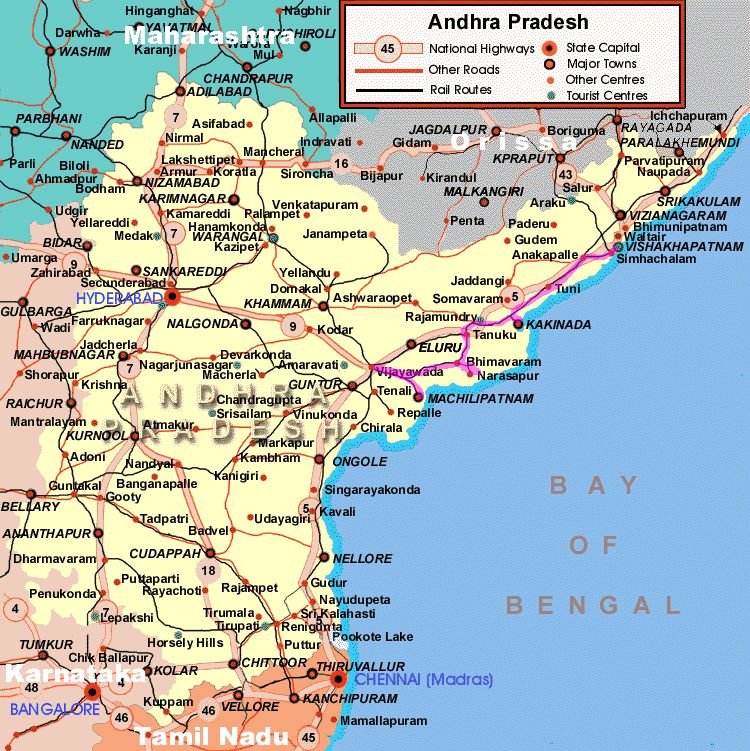
The trip route
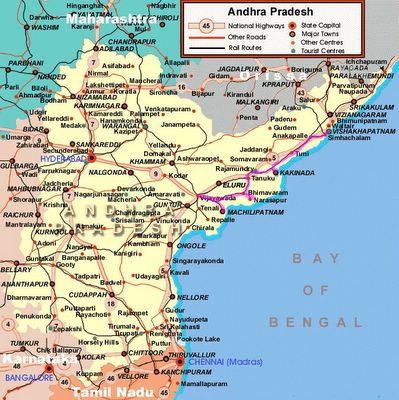
In this map the route is marked in pink. Not all places are on this map but atleast it would indicate the rough coordinates of the places visited.
Sunday, March 13, 2005
nearing end of the travel (or atleast so it seems...)
Need to finish this travel story real quickly. There are too many things that are close to completion but then the end seems no where in sight...
In the last leg of the tour, I would take you'll through, Pedanna, Machilipatnam, Kuchipudi, Ghantasala and Vijayawada. I would be very proud of myself if I can say all that I want to say about these places in one eloquent blog but then eloquence is bit beyond me right now. So would have to be bore and tell you'll everything.
After making a quick get away from Kaikalur, we were in no mood to stop and look. What was there to look in West Godavari (WG) anyway? While on the way, RJ was in pain due to his cramps and we did not engage in any small talk. I was looking forward to reaching Machilipatnam and so was he. The driver after few trial and errors found the right route to get there. We went past through Narsapur, Palakol, Amalapuram (perhaps) and onto Pedanna. Though we were supposed to visit this village the next day, since it pleasantly appeared on our radar we decided to stop and finish our work here.
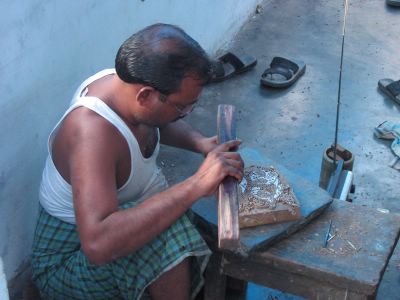
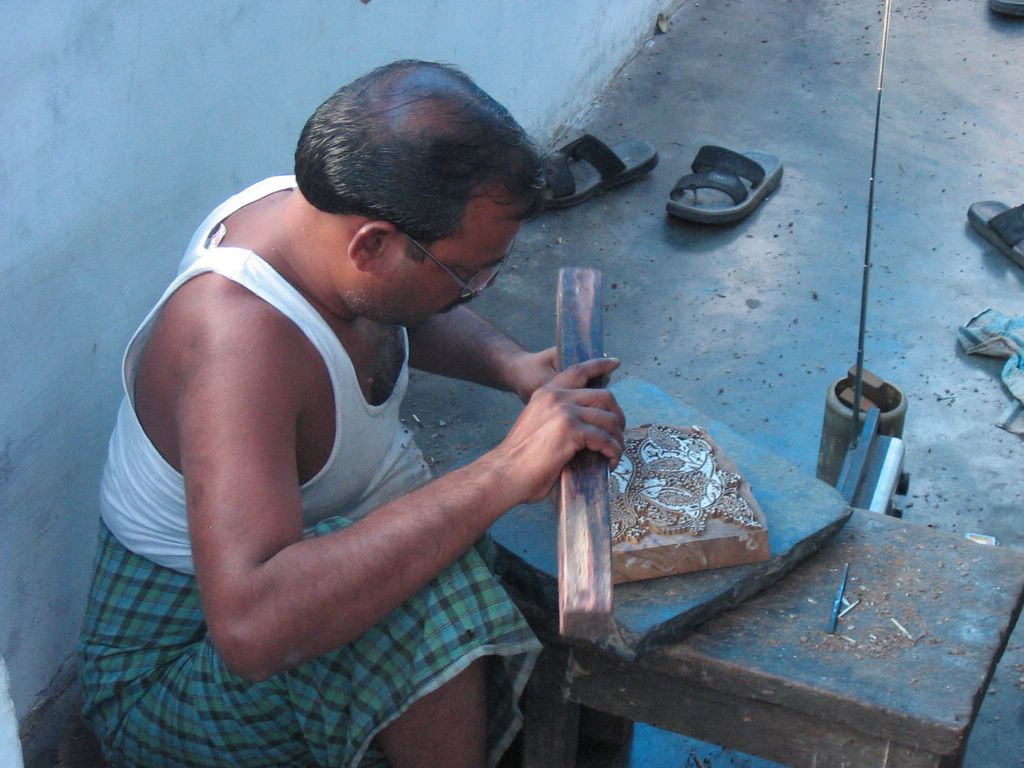
Pedana is a town famous for Kalamkari. Actually block type Kalamkari. The other version is free hand Kalamkari, an art that is still thriving in Kalahasti. Unlike the block printing of Rajasthan, artisan here use natural colours. This was my first trip here. Unlike many craft villages, P is large and could almost be a town. However, it was not difficult for us to find out where the block maker we wanted to visit lived. He apparently is the only block maker in the village which made our job easy. Most of the large merchants in Pedana in the past had their blocks made in Gujarat. Our man is from Telangana and so is careful not to step on local merchants’ feet by starting his own block printing unit even though he was tempted. He mostly makes blocks and trains people in block making. As he was given the 'master craftsmen' award from the centre, the handicraft department supports training about 20 local youth in block making.
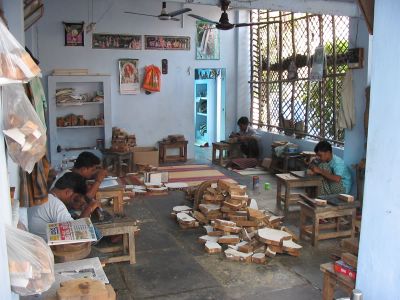
Youth being trained in block making
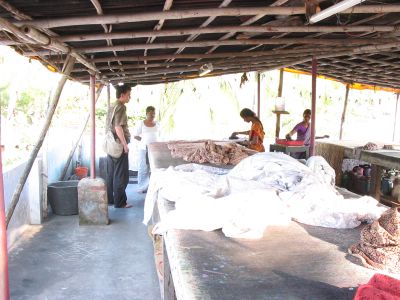
Block printing in progress
In the last 5-6 years there has been a great setback to the Kalamkari industry due to markets drying up but this year export orders have started picking up and the demand for blocks is going up. With this rather positive news, he shows us how blocks are made and also shows us the block that clinched him the award. It was an exquisitely carved piece that would print a paisley design. However, what caught my eye was a print on his wall that resembled an Escher mosaic. The work was not as intricate as an Escher but then the patterns were the same: various pictures that gel into one and another. The blocks for that print were sent to some client long ago but before he sent them, he printed them on a sheet of paper, framed it and put it up on his wall.
Anyway, in short he is doing well and would like to have more local youth joining him as he has large number of orders. To finish them he hired help from Rajasthan but then he says they pack up and leave the minute they feel homesick and hence the look out for the local youth.
Contended that something went well that afternoon, we set out to Machilipatnam. I have always wanted to go to this town as it is brimming with history. British, French and Dutch had their establishments here and for years, this town was one of the main ports on the East coast. I was expecting a lot of heritage buildings, narrow streets full of character, old restaurants but then I was disappointed on all fronts. This place was just like any small town. However, unlike the rest of small towns, the roads were very wide. Also, Machilipatnam is where Andhra Bank was founded but then founder branch was no great shakes. It seemed like any other branch only exception is that it has a statue of Pattabi Seetaramayya, the man who started it and a set of steps in iron grill right next to it.
There were hardly any decent hotels in this town to add to it we could not find any good restaurants close by. Instead of hunting for one, we decided to eat early at a tiffin joint not far away. While we were eating, one of the local chaps in the next table came up to RJ and said ‘I know some lines in your language’. RJ looked up and said, tell me... and this person rattled some lines that did seem like any European language. RJ asked him to repeat them. Still no idea what it was. So I asked him about what the lines meant. He said, these lines were in some Telugu novel he read many year ago which the protagonist says to a European woman meaning 'I want to kiss you' (or something in similar lines). He memorised the words and waited for a day when he could put them to use or at least surprise some European woman. Although I told him that I appreciated the effort he took to keep these lines in his memory for years, his friends however had a good laugh at his expense.
After dinner, we went for a walk along the main road to hunt for a cyber cafe. We were directed to one close to a cinema hall. It was place where one had to enter after removing one's footwear. There were many such places during the early days of cyber cafes but then the establishment of this venture likes to uphold traditional values. On our way back, we had a long chat with few local at a Tea centre to find out if there were any forts in the neighbourhood. We were told that there aren’t any in this town but there is one in a village not far away. We immediately decided to stop there the first thing in the morning.
In the last leg of the tour, I would take you'll through, Pedanna, Machilipatnam, Kuchipudi, Ghantasala and Vijayawada. I would be very proud of myself if I can say all that I want to say about these places in one eloquent blog but then eloquence is bit beyond me right now. So would have to be bore and tell you'll everything.
After making a quick get away from Kaikalur, we were in no mood to stop and look. What was there to look in West Godavari (WG) anyway? While on the way, RJ was in pain due to his cramps and we did not engage in any small talk. I was looking forward to reaching Machilipatnam and so was he. The driver after few trial and errors found the right route to get there. We went past through Narsapur, Palakol, Amalapuram (perhaps) and onto Pedanna. Though we were supposed to visit this village the next day, since it pleasantly appeared on our radar we decided to stop and finish our work here.
Pedana is a town famous for Kalamkari. Actually block type Kalamkari. The other version is free hand Kalamkari, an art that is still thriving in Kalahasti. Unlike the block printing of Rajasthan, artisan here use natural colours. This was my first trip here. Unlike many craft villages, P is large and could almost be a town. However, it was not difficult for us to find out where the block maker we wanted to visit lived. He apparently is the only block maker in the village which made our job easy. Most of the large merchants in Pedana in the past had their blocks made in Gujarat. Our man is from Telangana and so is careful not to step on local merchants’ feet by starting his own block printing unit even though he was tempted. He mostly makes blocks and trains people in block making. As he was given the 'master craftsmen' award from the centre, the handicraft department supports training about 20 local youth in block making.
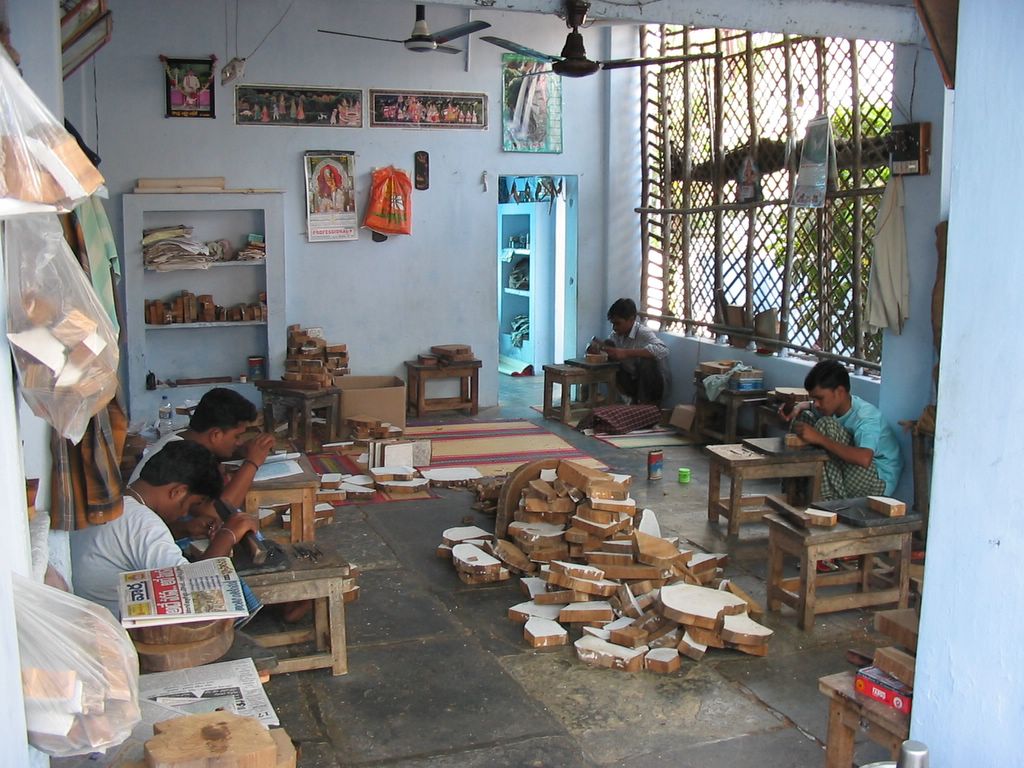
Youth being trained in block making
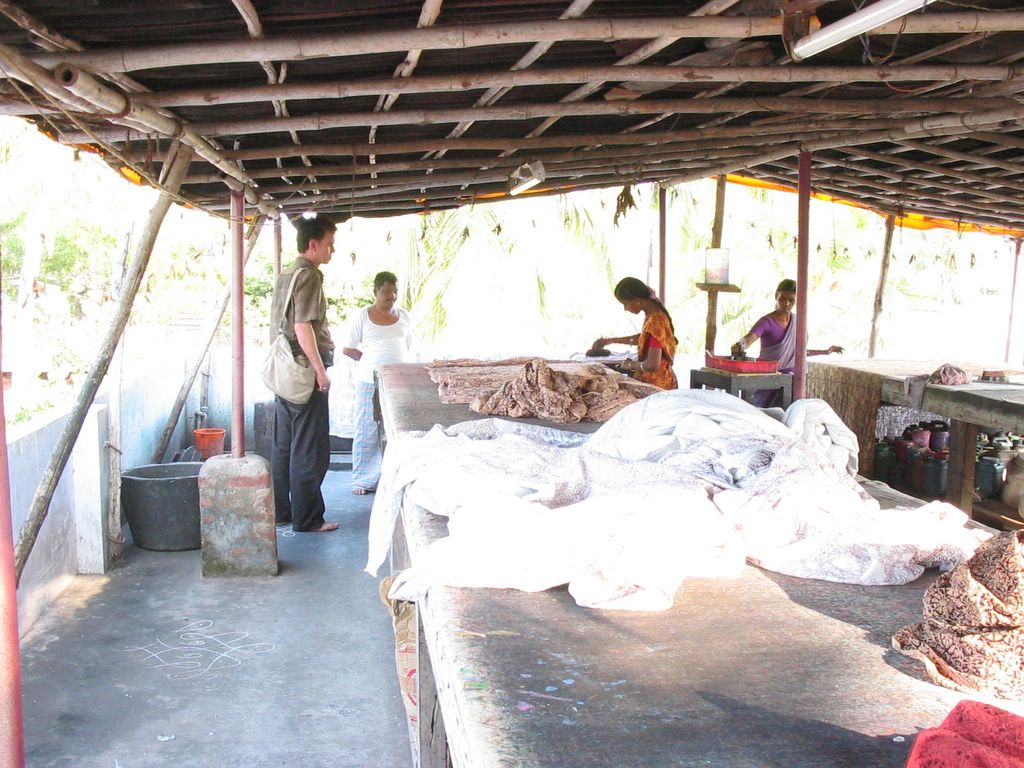
Block printing in progress
In the last 5-6 years there has been a great setback to the Kalamkari industry due to markets drying up but this year export orders have started picking up and the demand for blocks is going up. With this rather positive news, he shows us how blocks are made and also shows us the block that clinched him the award. It was an exquisitely carved piece that would print a paisley design. However, what caught my eye was a print on his wall that resembled an Escher mosaic. The work was not as intricate as an Escher but then the patterns were the same: various pictures that gel into one and another. The blocks for that print were sent to some client long ago but before he sent them, he printed them on a sheet of paper, framed it and put it up on his wall.
Anyway, in short he is doing well and would like to have more local youth joining him as he has large number of orders. To finish them he hired help from Rajasthan but then he says they pack up and leave the minute they feel homesick and hence the look out for the local youth.
Contended that something went well that afternoon, we set out to Machilipatnam. I have always wanted to go to this town as it is brimming with history. British, French and Dutch had their establishments here and for years, this town was one of the main ports on the East coast. I was expecting a lot of heritage buildings, narrow streets full of character, old restaurants but then I was disappointed on all fronts. This place was just like any small town. However, unlike the rest of small towns, the roads were very wide. Also, Machilipatnam is where Andhra Bank was founded but then founder branch was no great shakes. It seemed like any other branch only exception is that it has a statue of Pattabi Seetaramayya, the man who started it and a set of steps in iron grill right next to it.
There were hardly any decent hotels in this town to add to it we could not find any good restaurants close by. Instead of hunting for one, we decided to eat early at a tiffin joint not far away. While we were eating, one of the local chaps in the next table came up to RJ and said ‘I know some lines in your language’. RJ looked up and said, tell me... and this person rattled some lines that did seem like any European language. RJ asked him to repeat them. Still no idea what it was. So I asked him about what the lines meant. He said, these lines were in some Telugu novel he read many year ago which the protagonist says to a European woman meaning 'I want to kiss you' (or something in similar lines). He memorised the words and waited for a day when he could put them to use or at least surprise some European woman. Although I told him that I appreciated the effort he took to keep these lines in his memory for years, his friends however had a good laugh at his expense.
After dinner, we went for a walk along the main road to hunt for a cyber cafe. We were directed to one close to a cinema hall. It was place where one had to enter after removing one's footwear. There were many such places during the early days of cyber cafes but then the establishment of this venture likes to uphold traditional values. On our way back, we had a long chat with few local at a Tea centre to find out if there were any forts in the neighbourhood. We were told that there aren’t any in this town but there is one in a village not far away. We immediately decided to stop there the first thing in the morning.
Tuesday, February 22, 2005
Riverbanks and aqua ponds....
After I managed to get hold of RJ and after he finished his photo session, we had breakfast in a small local ‘parlour’. While we ate, we tried to chart out a route on a not too precise tourist map. The map showed a line across Godavari next to Kotipalli Reevu. I have heard that it is a beautiful spot so wanted to head there.
After going past more green fields, we get to this small village Kotipalli with flashes of Godavari between houses. At the end of the village, a small road leads to a small ghat with steps leading to the river. On the left part of the Ghat was a large Banyan tree with a raised platform all around it that seated some men, animals and gods. The idols were smeared with turmeric and kunkum. A tiny path circling the banyan tree leads to a small jetty. From this jetty, a ferry transported people and vehicles on to the other bank. There was no bridge. So yet another mistake on the map. All around the Ghat were small shops selling assorted ware: from Telugu song books to batteries to 'cool drinks' to bakery products.
While we were looking around, the driver found out that the ferry could transport the car even. However, we were keen on finding a bridge across the river. The locals said that the only bridge close by is Yanam Bridge. We looked at the map and it showed no signs of this bridge. The bridge has apparently been renamed after the erstwhile Lok Sabha speaker Balayogi. (Yanam is a small town close to Kakinada, which is a part of the Union territory of Pondicherry).
Instead of taking the main route, we decided to take the road that ran alongside the river. The road was all along a raised bund that separated the land from the high flood levels of the river. Though the road very narrow and absolutely lousy, the scenes it provided us were fantastic: green paddy fields on our left and a lovely river on our right that was shimmering in almost mid day light, that was brought down to a manageable level by the tinted windows of the car. After a while when opportunity presented us a larger and smoother road that would take us to the bridge quicker, we took it. But not without stopping by and clicking few photos.
In no time, we crossed the river, went past some nice quaint places like Razole and normal dusty towns like Bhimavaram, Narsapur, etc. only to reach one of the most horrible places - Kaikalur - for lunch.
We entered West Godavari somewhere after Razole.There is marked differences between the two Godavari districts. While East Godavari is full of lush green paddy fields, West Godavari (or atleast the part that we were travelling through) is full of aqua ponds with nets hanging over them to protect the cash rich aqua products from being eaten by birds. It was depressing to see these rich fertile lands being converted into irreversible aqua ponds. These ponds are filled with brackish water to grow shrimp, prawns etc. In Vizag district, most of the aqua crop had a virus attack due to excessive farming. This outbreak not only ruined that particular crop but also the reputation of the whole industry. This lead to many companies going bankrupt or loosing lakhs of rupees. The farmers who leased out their lands to aqua companies cannot till the land anymore so, in certain parts of Vizag has large tracts of lands that are lying wasted.
Getting back to the West Godavari aqua farming, Kaikalur seemed to be the centre all the activity. It seems that Kolleru lake, the largest freshwater lake in AP has been encroached all around by aqua ponds, Kaikalur being the largest town in the vicinity seems to have taken this development in its stride. Just about every business is related to this aqua culture. So much so for the chapter in our school telugu book “Kolleti Kongalu” (literally it would mean cranes of Kolleru but it was basically on pelicans, which are in large number in this lake). We actually took this route in hope of finding a restaurant or a place overlooking the lake. Perhaps there is but we were in no mood to search.
To add to the woes (RJ had stomach cramps), I did not feel like eating at all the Veg-Non Veg joints but wanted to look for a pure Veg place. Don’t know why but just did not feel like being a part of the system around. Normally, I tend not to be too emotional about things but then in Kaikalur, the discomfort of travel and my thought may played up on my mind and I refused to eat at any other place. We had to travel up and down the main road at least two times, before we did manage to find a small thatch roofed joint serving Veg Andhra meals. RJ decided to skip a meal.
After the meal both RJ and I were happily to get out of this depressing town and be as far away from Kaikalur as possible.
Some pics here
After going past more green fields, we get to this small village Kotipalli with flashes of Godavari between houses. At the end of the village, a small road leads to a small ghat with steps leading to the river. On the left part of the Ghat was a large Banyan tree with a raised platform all around it that seated some men, animals and gods. The idols were smeared with turmeric and kunkum. A tiny path circling the banyan tree leads to a small jetty. From this jetty, a ferry transported people and vehicles on to the other bank. There was no bridge. So yet another mistake on the map. All around the Ghat were small shops selling assorted ware: from Telugu song books to batteries to 'cool drinks' to bakery products.
While we were looking around, the driver found out that the ferry could transport the car even. However, we were keen on finding a bridge across the river. The locals said that the only bridge close by is Yanam Bridge. We looked at the map and it showed no signs of this bridge. The bridge has apparently been renamed after the erstwhile Lok Sabha speaker Balayogi. (Yanam is a small town close to Kakinada, which is a part of the Union territory of Pondicherry).
Instead of taking the main route, we decided to take the road that ran alongside the river. The road was all along a raised bund that separated the land from the high flood levels of the river. Though the road very narrow and absolutely lousy, the scenes it provided us were fantastic: green paddy fields on our left and a lovely river on our right that was shimmering in almost mid day light, that was brought down to a manageable level by the tinted windows of the car. After a while when opportunity presented us a larger and smoother road that would take us to the bridge quicker, we took it. But not without stopping by and clicking few photos.
In no time, we crossed the river, went past some nice quaint places like Razole and normal dusty towns like Bhimavaram, Narsapur, etc. only to reach one of the most horrible places - Kaikalur - for lunch.
We entered West Godavari somewhere after Razole.There is marked differences between the two Godavari districts. While East Godavari is full of lush green paddy fields, West Godavari (or atleast the part that we were travelling through) is full of aqua ponds with nets hanging over them to protect the cash rich aqua products from being eaten by birds. It was depressing to see these rich fertile lands being converted into irreversible aqua ponds. These ponds are filled with brackish water to grow shrimp, prawns etc. In Vizag district, most of the aqua crop had a virus attack due to excessive farming. This outbreak not only ruined that particular crop but also the reputation of the whole industry. This lead to many companies going bankrupt or loosing lakhs of rupees. The farmers who leased out their lands to aqua companies cannot till the land anymore so, in certain parts of Vizag has large tracts of lands that are lying wasted.
Getting back to the West Godavari aqua farming, Kaikalur seemed to be the centre all the activity. It seems that Kolleru lake, the largest freshwater lake in AP has been encroached all around by aqua ponds, Kaikalur being the largest town in the vicinity seems to have taken this development in its stride. Just about every business is related to this aqua culture. So much so for the chapter in our school telugu book “Kolleti Kongalu” (literally it would mean cranes of Kolleru but it was basically on pelicans, which are in large number in this lake). We actually took this route in hope of finding a restaurant or a place overlooking the lake. Perhaps there is but we were in no mood to search.
To add to the woes (RJ had stomach cramps), I did not feel like eating at all the Veg-Non Veg joints but wanted to look for a pure Veg place. Don’t know why but just did not feel like being a part of the system around. Normally, I tend not to be too emotional about things but then in Kaikalur, the discomfort of travel and my thought may played up on my mind and I refused to eat at any other place. We had to travel up and down the main road at least two times, before we did manage to find a small thatch roofed joint serving Veg Andhra meals. RJ decided to skip a meal.
After the meal both RJ and I were happily to get out of this depressing town and be as far away from Kaikalur as possible.
Some pics here
Wednesday, February 16, 2005
of a temple (the road trip contd...)
Considering that we were to travel from

Even before I could finish sighing, which is more of an indicator of my long sigh than short distance, we reached Draksharamam, a Shiva temple. The temple had a small entrance that leads to a very large square complex. All around the main temple was a wide raised path that was Cuddapah stone topped. Instead of going into the temple, we decided to walk around the complex first.
When we reached the other side of the temple, as some puja to an open air deity was completed and the priests were giving everyone theertham and bananas to all those who attended it. As there were few more bananas left, we were called out. After being blessed on accepting the prasadam, we walked back to the front.
I then noticed that some restoration work was being done with the help of Archeological Society of India (as the large board said). I further noticed that most of the workers were Muslims perhaps from UP who were happily chatting in chaste Hindi/Urdu as they chipped the edges of the stone slabs, which would later be placed just around the plinth of the main temple. Perhaps to stop seepage of rain water along the temple foundation. RJ and I had to stop our romantic chat about this inter-religious interaction as we came to a large banyan tree with a circular platform around it. All around the platform there were idols that had entwined snakes carved on them. People were walking around the platform, hands folded and in silent reverence.
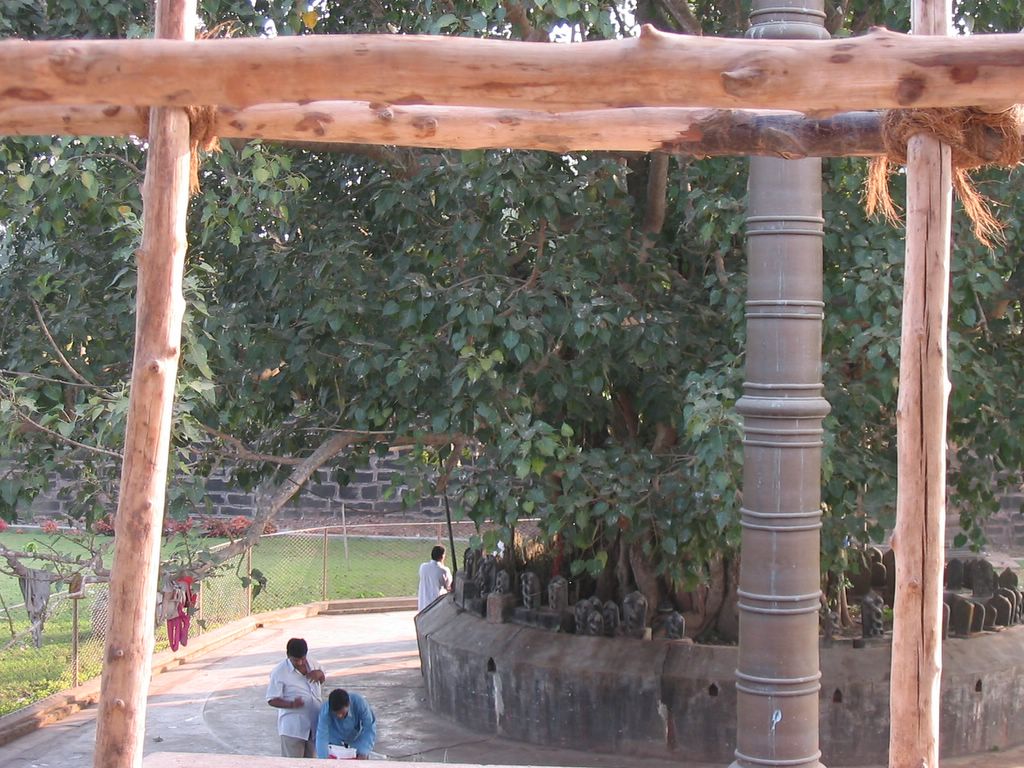
From this platform, a path on the right leads to the main temple in the centre. When we entered, what we thought was the main temple was infact another square complex. The temple was in the middle of this smaller complex. The complex had a pillared hall that ran all around the temple, where few puja were being done and few more were in the process of being initiated.
One part of the hall had another floor to it with an iron ramp that leads to another level of the main temple. I realised main temple has two levels and the ramp connects the first floor of the hall to the first floor of the temple.

The main deity was a tall lingam, which could have been a part of a Buddhist monastery. I have a feeling that many Buddhist stupas in this area could have been converted into Hindu temples. Amaravati and Annavaram are two temples that I visited which had Buddhist activity around and have tall structures that are said to be Shiva lingams, with a lovely story as to why this Lingam is taller than the usual ones. So, Draksharamam could also be one such entity. Before I get flamed, I would have to say that this is my theory or rather my hunch and has no academic support to it.
Wednesday, January 26, 2005
Of food, looms and boats.
I am always interested in finding out nice small places to eat, where ever I am. I usually ask the local people while drinking tea at a tiny roadside joint or when I am travelling in an auto or even when I make a call from the local STD booth. Even if I don't eat at this place, this piece of info could be of use at some other point to time. More often than not, I am never disappointed with the recos. Few years ago, I stumbled upon Raja Rajeswari Palghat Mess opposite the Pithapuram railway station. The local auto driver recommended this place, said it is run by Palghat Iyers who came to P few decades ago and that it is a nice place to eat. So both of us decided to have our lunch there, as I hired the auto for the whole day.
This was a place in a typical 'shopping complex' that are becoming popular in many small towns. They are a series of shops mostly running parallel to the main street of that place and the main gutter. At times, the shopping complex could also be perpendicular to the main street in which case the shops are on either side of a long corridor with the entrance being on the main street. Usually, there are two wheelers both motorised and non-motorised parked haphazardly in front of these complexes. Of the two I like those running parallel to the main street, it has more light coming in; although there would be more dust. The other kind of shopping complex are dingy and damp. Well, dust can build up immune system.
Coming back to our RRPM, it is a two floored venture in a 'parallel' kind of shopping complex. On the ground floor was the 'tiffin' section. The first floor was the 'meals' section. The kitchen was on the ground floor just after the steps. Around the payment counter was a large display that contained various ' hot and sweet specialities'. Both the driver and I went straight to the first floor. The meal was served on a plantain leaf and was ok. It has the usual dal, one fried curry, one masala curry, ..... but then the lime pickle was great. So, while paying the bill, I asked if they sold pickle. They did and I purchased 5 quarter kilo packs that I wanted to distribute among my cousins. That did not happen as my mother who rarely eats pickle wanted all of them and I gave them to her. Though I have tried to get back to this place over the next few months of my data collection, there was never an opportunity to do so.
Considering this past, I was looking forward to be at RRPM once again. This time, the plantain leaf was no long there but a green plastised paper cut into a leaf form was put in front of us. I did not like it but RJ liked this very much; he said it would make nice dinner plates back home if he had to serve Indian food. So the first thing on my menu was the pickle. I asked the waiter to bring sample of as many pickles as he can. Considering that they were being sold at Rs. 50 per kg, for 120 Rs. I had a wide variety of quarter kilos by the time we left.
We went to three hotels in Kakinada before deciding on Jaya International. The place was small and functional and was extremely well run. RJ decided to look for cyber cafe to send a mail to his wife and I wanted to catch up on some sleep that has eluded me through the Sankranti period. At 4 we start towards Uppada.
Uppada, as I mentioned earlier is a weaving village that is right next to the sea and so has a sizeable fishermen population. The handloom cluster of Uppada consists of only four or five villages. For years, these sarees were known in north Andhra as cheap but good ones. However, few years ago, the Weavers Service Centre in Vijayawada decided to teach these weavers how to weave Jamdani. This is a special weave due to which both the side of the saree look the same. There is no right side. The processes requiring three people is painstakingly slow and for some reasons this cluster quickly adopted this new weaving technique and some local weavers have started producing saree that are well into the Rs. 15,000 to 25,000 ranges with pure gold zari. However, one can find good Jamdani sarees for around 3000. Due to this new technique the whole cluster is prospering.
The road to Uppada from Kakinada is all along the sea and is very picturesque. As we approach Uppada, we have to travel past the many boats that are anchored close to the shore and few that are on the beach.
Here in Uppada, we had a long chat with the local entrepreneur who is into handloom business. He showed some of his new Jamdani products which he gets made in Venkatagiri near Tirupati as the labour is cheaper there. The weavers in Uppada have formed a union due to which they can negotiate increases in wages when necessary and this has prompted some people like KVR to start some contract weaving operation in Venkatagiri.
The production process in the cluster has been stopped due to the festival and would commence after 26th, said KVR. Otherwise, one would have to walk past meters of warp being sized in the street and the whole area would be filled with the thuds of wooden shuttle hitting the sides of the wooden loom as the sarees are being made.
Here are some more pics
This was a place in a typical 'shopping complex' that are becoming popular in many small towns. They are a series of shops mostly running parallel to the main street of that place and the main gutter. At times, the shopping complex could also be perpendicular to the main street in which case the shops are on either side of a long corridor with the entrance being on the main street. Usually, there are two wheelers both motorised and non-motorised parked haphazardly in front of these complexes. Of the two I like those running parallel to the main street, it has more light coming in; although there would be more dust. The other kind of shopping complex are dingy and damp. Well, dust can build up immune system.
Coming back to our RRPM, it is a two floored venture in a 'parallel' kind of shopping complex. On the ground floor was the 'tiffin' section. The first floor was the 'meals' section. The kitchen was on the ground floor just after the steps. Around the payment counter was a large display that contained various ' hot and sweet specialities'. Both the driver and I went straight to the first floor. The meal was served on a plantain leaf and was ok. It has the usual dal, one fried curry, one masala curry, ..... but then the lime pickle was great. So, while paying the bill, I asked if they sold pickle. They did and I purchased 5 quarter kilo packs that I wanted to distribute among my cousins. That did not happen as my mother who rarely eats pickle wanted all of them and I gave them to her. Though I have tried to get back to this place over the next few months of my data collection, there was never an opportunity to do so.
Considering this past, I was looking forward to be at RRPM once again. This time, the plantain leaf was no long there but a green plastised paper cut into a leaf form was put in front of us. I did not like it but RJ liked this very much; he said it would make nice dinner plates back home if he had to serve Indian food. So the first thing on my menu was the pickle. I asked the waiter to bring sample of as many pickles as he can. Considering that they were being sold at Rs. 50 per kg, for 120 Rs. I had a wide variety of quarter kilos by the time we left.
We went to three hotels in Kakinada before deciding on Jaya International. The place was small and functional and was extremely well run. RJ decided to look for cyber cafe to send a mail to his wife and I wanted to catch up on some sleep that has eluded me through the Sankranti period. At 4 we start towards Uppada.
Uppada, as I mentioned earlier is a weaving village that is right next to the sea and so has a sizeable fishermen population. The handloom cluster of Uppada consists of only four or five villages. For years, these sarees were known in north Andhra as cheap but good ones. However, few years ago, the Weavers Service Centre in Vijayawada decided to teach these weavers how to weave Jamdani. This is a special weave due to which both the side of the saree look the same. There is no right side. The processes requiring three people is painstakingly slow and for some reasons this cluster quickly adopted this new weaving technique and some local weavers have started producing saree that are well into the Rs. 15,000 to 25,000 ranges with pure gold zari. However, one can find good Jamdani sarees for around 3000. Due to this new technique the whole cluster is prospering.
The road to Uppada from Kakinada is all along the sea and is very picturesque. As we approach Uppada, we have to travel past the many boats that are anchored close to the shore and few that are on the beach.
Here in Uppada, we had a long chat with the local entrepreneur who is into handloom business. He showed some of his new Jamdani products which he gets made in Venkatagiri near Tirupati as the labour is cheaper there. The weavers in Uppada have formed a union due to which they can negotiate increases in wages when necessary and this has prompted some people like KVR to start some contract weaving operation in Venkatagiri.
The production process in the cluster has been stopped due to the festival and would commence after 26th, said KVR. Otherwise, one would have to walk past meters of warp being sized in the street and the whole area would be filled with the thuds of wooden shuttle hitting the sides of the wooden loom as the sarees are being made.
Here are some more pics
Saturday, January 22, 2005
The road trip contd....
As we travelled to 'Koppaka, as the locals call Etikoppaka, some the chicken that were to make the day's delicacies were being plucked and roasted on fires made from hay in the fields along the road. This road would take us to Narsipatnam but to go to Koppaka, we had to turn right to go to Daarapudi village. As I was not sure where exactly to turn right, we stopped some where along the road to ask direction. Though I have travelled many times to Koppaka but normally we take another route. As we had to eat at
few pics at the other blog site
Thursday, January 20, 2005
The road trip (Part 1)
Last week I went on a three day trip from Visakhapatnam to Vijayawada. The deal was to visit some interesting places between these two cities so that they could be a part of tour that a friend of mine - RJ was planning to organise in Jan 2007. He made a short trip last year along this area but this time he wanted to do a bit more research about the hotels to stay and eat along the way. Tentatively the plan was to stay one night in Kakinada and another in Machilipatnam and use the days to visit nearby town and villages. We decided to start at 6 in the morning on 16th and eat breakfast somewhere after Ellamanchili.
The day started off well, we managed to leave by 6.30, even though I slept for few hours the previous night (my extended family was in sankranti revelry mode that mainly constituted of playing three cards and visiting a 24 hour coffee shop of a local hotel into the wee hours of the morning). The new highway was smooth and empty, in no time we reached the steel plant zone where we took the "Anakapalle and Ellamanchilli" by-pass. Over the years, a detour through the steel plant has been the favourite route for many non commercial travellers considering the fact that heavy duty lorries avoided this route as it involved paying toll twice.
The area beyond the steel plant was completely god forsaken until NTPC decided to set up a thermal power unit. Even as recent as 1997, the land rates here were about Rs.30, 000 an acre. NTPC gave a compensation of 1.2 lakhs an acre without the guarantee of a job in the unit (while acquiring land for steel plant the govt gave local rates but also gave a job per family) ever since then, fuelled by the previous government's mode of sanctioning large tracts of land for various industrial zones, the land rates are touching the roof (Rs. 25 lakhs an acre for a road side plot and the price tapers down proportional to the distance from the road) and are showing no signs of abating. Imagine how financially brilliant I am, when in 1997, I purchased a motor bike for Rs. 45,000 (my savings in Germany) even as some people were trying to sell me a piece of land in this zone for 25K an acre.
Anyway, getting back to the road trip, the first intended stop was Etikopakka, the wooden toy village. In this village for over hundred years, craftsmen have been producing lacquered finished wooden products that were sold mostly at fairs and temple in the local region. Some of you may have heard the term lakka pidatalu, little wooden kitchen set that is still very popular in spite of the plastic variations available in the market. However, due to difficulties in production due to the hindrance of the forest department as the wood was a forest produce and due to difficulties in making the products, the whole industry was on the verge of disappearing. It was due to some NGOs in the vicinity that the industry was revived. Once certain critical mass of trained craftsmen were available, few of the local persons got involved in the trade and have started making some wonderful products using natural colours. (pics posted in this blog)
I thought there should be some decent places to eat on the highway after Ellamanchili but then the day was being celebrated as mu-kanumu (which incidentally was the previous day but since it was a Saturday, a day when most of the north andhrites restrain from eating meat) and most of the local markets like Paravada, Achutapuram, which normally are vegetable markets, were filled with chicken and mutton sellers. None of the shops or eating places were open. However, I was sure that some places near Adda Road (an intersection on NH 5 that connected the tribal areas on Eastern Ghats behind Narsipatnam and the coastal areas beyond S.Rayavaram) but that was not the case, most of the shops were closed and the meat sellers were having a field day. Adda Road is a settlement that developed only along the junction, so by going left... u-turn... left... u-turn... left... u-turn and left one would complete the trip of the settlement and reach the starting point. We found a small place with a typical aluminum idli vessel on a smoke-less chula (a coal fired stove with a smoke chimney) but the idlis weren’t done as yet. While the driver and I went to relive ourselves 'around the corner' (which in real terms did not exist in this place), RJ plonked himself on the wooden bench inside the 'hotel'. By the time I came back, RJ had a plate of three steaming idli's in front of him. In no time, the place was filled with people either eating or taking a 'parcel'. With our hunger satiated, we headed to Etikopakka.
actually wanted to end the first part after Etikoppaka but considering that it would be part of the next blog, I decided to put up two pictures as a bait to read my next part :)
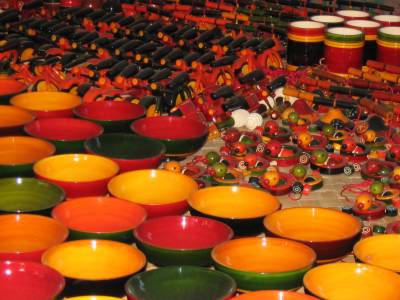
wooden products
The day started off well, we managed to leave by 6.30, even though I slept for few hours the previous night (my extended family was in sankranti revelry mode that mainly constituted of playing three cards and visiting a 24 hour coffee shop of a local hotel into the wee hours of the morning). The new highway was smooth and empty, in no time we reached the steel plant zone where we took the "Anakapalle and Ellamanchilli" by-pass. Over the years, a detour through the steel plant has been the favourite route for many non commercial travellers considering the fact that heavy duty lorries avoided this route as it involved paying toll twice.
The area beyond the steel plant was completely god forsaken until NTPC decided to set up a thermal power unit. Even as recent as 1997, the land rates here were about Rs.30, 000 an acre. NTPC gave a compensation of 1.2 lakhs an acre without the guarantee of a job in the unit (while acquiring land for steel plant the govt gave local rates but also gave a job per family) ever since then, fuelled by the previous government's mode of sanctioning large tracts of land for various industrial zones, the land rates are touching the roof (Rs. 25 lakhs an acre for a road side plot and the price tapers down proportional to the distance from the road) and are showing no signs of abating. Imagine how financially brilliant I am, when in 1997, I purchased a motor bike for Rs. 45,000 (my savings in Germany) even as some people were trying to sell me a piece of land in this zone for 25K an acre.
Anyway, getting back to the road trip, the first intended stop was Etikopakka, the wooden toy village. In this village for over hundred years, craftsmen have been producing lacquered finished wooden products that were sold mostly at fairs and temple in the local region. Some of you may have heard the term lakka pidatalu, little wooden kitchen set that is still very popular in spite of the plastic variations available in the market. However, due to difficulties in production due to the hindrance of the forest department as the wood was a forest produce and due to difficulties in making the products, the whole industry was on the verge of disappearing. It was due to some NGOs in the vicinity that the industry was revived. Once certain critical mass of trained craftsmen were available, few of the local persons got involved in the trade and have started making some wonderful products using natural colours. (pics posted in this blog)
I thought there should be some decent places to eat on the highway after Ellamanchili but then the day was being celebrated as mu-kanumu (which incidentally was the previous day but since it was a Saturday, a day when most of the north andhrites restrain from eating meat) and most of the local markets like Paravada, Achutapuram, which normally are vegetable markets, were filled with chicken and mutton sellers. None of the shops or eating places were open. However, I was sure that some places near Adda Road (an intersection on NH 5 that connected the tribal areas on Eastern Ghats behind Narsipatnam and the coastal areas beyond S.Rayavaram) but that was not the case, most of the shops were closed and the meat sellers were having a field day. Adda Road is a settlement that developed only along the junction, so by going left... u-turn... left... u-turn... left... u-turn and left one would complete the trip of the settlement and reach the starting point. We found a small place with a typical aluminum idli vessel on a smoke-less chula (a coal fired stove with a smoke chimney) but the idlis weren’t done as yet. While the driver and I went to relive ourselves 'around the corner' (which in real terms did not exist in this place), RJ plonked himself on the wooden bench inside the 'hotel'. By the time I came back, RJ had a plate of three steaming idli's in front of him. In no time, the place was filled with people either eating or taking a 'parcel'. With our hunger satiated, we headed to Etikopakka.
actually wanted to end the first part after Etikoppaka but considering that it would be part of the next blog, I decided to put up two pictures as a bait to read my next part :)

wooden products

wooden products 2
Friday, January 07, 2005
swahili experiences...
Now that we were on land again, that too without getting wet, we decided to celebrate by getting something to eat at the best shack in front of the sea. It was while the food was being prepared, which took a long time as no one was in a hurry, I said we should plan a bit on what we should be doing; more importantly on where we should be staying. However, the first thing Kieron wanted to do was to find his sister.
His sister and her friend were with their two African boyfriends. Who, in true Hindi filmi style became their b.f. after they 'saved' these girls from certain pestering creatures in the lanes of Old Mombassa. However, normally it would have been easy to stalk out two white girls with their local boyfriends as everyone would have been talking about them, but then Lamu is another place.
Somehow, the hippies of the seventies (or was it the sixties?) 'found' Lamu. I say somehow as it beats me how on earth did they get to this piece of island in Indian Ocean, close to Somalia border, of all the places in the world. So since the time Lamu and the islands around it have been 'found', the locals have seen many 'romances' that end up nowhere. Well in these case its the means that matter not the ends. I am not saying that person A should fall in love with someone of his or her own ilk but then one can easily see that these romances, considering the discrepancies between the two parties, have rather short lives. Which in many cases is mutually beneficial. Few days later I met an artist who lovingly showed me a picture of his daughter living in Sweden. His ex, he said, sends the daughter once in a while to Lamu. He went to Sweden once, the lady paid.
Anyway getting back to the story, our meal took a long time to come and longer time to finish. If this meal was the sign of things to come, I could see that it is going to be one unhurried holiday. After we stepped out, Kieron caught hold of couple of 'beach boys' who can give assistance for many 'tourist activities' that are offered here. He soon found out where his sister was staying and that they went out on a dhow to someplace to swim. Instead of waiting for them to find out if they had a room for us, we decided to look for one ourselves.
Lamu, has one long sea facing road, which is the only road where a vehicle could move. The rest of the town is lost in a flurry of small lanes. After the first row of sea facing buildings which include a bank and a museum, is the next widest lane. On this lane one could find many interesting buildings including few mosques and a small fort.
Right after the small square in front of the fort was a small movie hall which to my surprise was playing an Amitabh movie. Even more surprising was that it was a all woman show. Until then I never realised the potential of Bollywood to transcend the barriers of language and culture. After all it is just not us who like our hero to float with his lady love like a butterfly and sting a few baddies like a bee. Would have like to see a movie in this theater but considering the fact that a Sanjay Dutt movie was to be shown next, I decided against it.
With no difficulty, we found a room in one of the houses close to the fort. This was a large room on the first floor of a Swahili house with two separate four post beds on which mosquito nets were hanging. Two small windows overlook the street and into the house on the opposite side. After having a wash in a open roof bathroom with a tin door, we set out again.
While walking on the sea front, Kieron stopped once in a while to greet and catch up with old friends. We also wanted to 'charter' a dhow the next day for a swim at one of the nice beach of an island close by. Lamu does not have a beach, the island ends and the sea begins, with lot of concrete blocks to stop the soil erosion.
Next day, it was my first trip on a dhow. Dhow is a traditional sail boat with two or more sails. It is wonderful to be on one of these with wind coming from behind and the boat effortless sailing over the water, without the sound of a motor. Just the swoosh of the water being cut by the stern of the boat. It is worth the experience. However, life on dhows is not always poetic. If the wind is too strong, it may tilt the boat dangerously. I have never seen it but Kieron tells me that to counter balance the force from the wind, a helper is literally made to 'walk the plank' and sit at the edge. However the boat I was in did tilt about 10- 20 degrees but not too dangerously. By the time we headed back, it was late in the evening and the dusk was falling and it was good to be sailing smoothly into the Lamu, with the lights turning on as we approached.
It was on this trip that we were told that some chaps organise a three day island hopping trip on a dhow with food included for the price. After Kieron translated that, I told him I was on. However, instead of we having the whole dhow to ourselves, we wanted to share it with some others.
After reaching Lamu, we went in search of a place to eat. When I was told that I could eat coconut rice with vegetable curry, little did I realise that this was all that I could get to eat on this island. The rest was sea food. Each time I asked is there anything veg, I would be replied "can I give some coconut rice with vegetable curry?" in a tone that kind of got to me after few days.
Thus our fist day at Lamu came to an end. Though we did nothing, we were unbelievably tired.
-----------------------------------------------------
Chaps I thought it would be three part series. It is already the third part and still someway to go. So, I have a request. Folks could you tell me which of the parts could have been culled to make it an interesting read?
His sister and her friend were with their two African boyfriends. Who, in true Hindi filmi style became their b.f. after they 'saved' these girls from certain pestering creatures in the lanes of Old Mombassa. However, normally it would have been easy to stalk out two white girls with their local boyfriends as everyone would have been talking about them, but then Lamu is another place.
Somehow, the hippies of the seventies (or was it the sixties?) 'found' Lamu. I say somehow as it beats me how on earth did they get to this piece of island in Indian Ocean, close to Somalia border, of all the places in the world. So since the time Lamu and the islands around it have been 'found', the locals have seen many 'romances' that end up nowhere. Well in these case its the means that matter not the ends. I am not saying that person A should fall in love with someone of his or her own ilk but then one can easily see that these romances, considering the discrepancies between the two parties, have rather short lives. Which in many cases is mutually beneficial. Few days later I met an artist who lovingly showed me a picture of his daughter living in Sweden. His ex, he said, sends the daughter once in a while to Lamu. He went to Sweden once, the lady paid.
Anyway getting back to the story, our meal took a long time to come and longer time to finish. If this meal was the sign of things to come, I could see that it is going to be one unhurried holiday. After we stepped out, Kieron caught hold of couple of 'beach boys' who can give assistance for many 'tourist activities' that are offered here. He soon found out where his sister was staying and that they went out on a dhow to someplace to swim. Instead of waiting for them to find out if they had a room for us, we decided to look for one ourselves.
Lamu, has one long sea facing road, which is the only road where a vehicle could move. The rest of the town is lost in a flurry of small lanes. After the first row of sea facing buildings which include a bank and a museum, is the next widest lane. On this lane one could find many interesting buildings including few mosques and a small fort.
Right after the small square in front of the fort was a small movie hall which to my surprise was playing an Amitabh movie. Even more surprising was that it was a all woman show. Until then I never realised the potential of Bollywood to transcend the barriers of language and culture. After all it is just not us who like our hero to float with his lady love like a butterfly and sting a few baddies like a bee. Would have like to see a movie in this theater but considering the fact that a Sanjay Dutt movie was to be shown next, I decided against it.
With no difficulty, we found a room in one of the houses close to the fort. This was a large room on the first floor of a Swahili house with two separate four post beds on which mosquito nets were hanging. Two small windows overlook the street and into the house on the opposite side. After having a wash in a open roof bathroom with a tin door, we set out again.
While walking on the sea front, Kieron stopped once in a while to greet and catch up with old friends. We also wanted to 'charter' a dhow the next day for a swim at one of the nice beach of an island close by. Lamu does not have a beach, the island ends and the sea begins, with lot of concrete blocks to stop the soil erosion.
Next day, it was my first trip on a dhow. Dhow is a traditional sail boat with two or more sails. It is wonderful to be on one of these with wind coming from behind and the boat effortless sailing over the water, without the sound of a motor. Just the swoosh of the water being cut by the stern of the boat. It is worth the experience. However, life on dhows is not always poetic. If the wind is too strong, it may tilt the boat dangerously. I have never seen it but Kieron tells me that to counter balance the force from the wind, a helper is literally made to 'walk the plank' and sit at the edge. However the boat I was in did tilt about 10- 20 degrees but not too dangerously. By the time we headed back, it was late in the evening and the dusk was falling and it was good to be sailing smoothly into the Lamu, with the lights turning on as we approached.
It was on this trip that we were told that some chaps organise a three day island hopping trip on a dhow with food included for the price. After Kieron translated that, I told him I was on. However, instead of we having the whole dhow to ourselves, we wanted to share it with some others.
After reaching Lamu, we went in search of a place to eat. When I was told that I could eat coconut rice with vegetable curry, little did I realise that this was all that I could get to eat on this island. The rest was sea food. Each time I asked is there anything veg, I would be replied "can I give some coconut rice with vegetable curry?" in a tone that kind of got to me after few days.
Thus our fist day at Lamu came to an end. Though we did nothing, we were unbelievably tired.
-----------------------------------------------------
Chaps I thought it would be three part series. It is already the third part and still someway to go. So, I have a request. Folks could you tell me which of the parts could have been culled to make it an interesting read?
Saturday, January 01, 2005
Chronicles of a spanish village as 'voices of the old sea'
In one of my earlier rambles, long time ago, I made some empty promises to review this book. Nonetheless, like a true person of modern times, I broke the promise and went on to start writing another series of blog. Which, incidentally, is yet to reach its final stop. Anyway, in a attempt to straighten up the matters, here is my first try to start the review process. I say review process since, before I start, I would like to take you'll on a slight detour as to how I got hold of this book. It is quite likely that this detour itself would fill up a blog by itself.
*(coming back from future, i can say: it did)*
This book was recommended to me by Robert, when I told him what kind of travel books I was looking for. R had a book stall at the weekly second hand book market at Spui (said Spow) in Amsterdam. Spui is a tiny square just off the main shopping street (Kalvestraat) of Amsterdam. Incidentally, this street few centuries ago was one of the first commodity market of the world, in addition to doubling up as the red light area once darkness fell. Years later, the authorities moved it around 'nieumarkt' area, where it still located. The red light area I mean. I have no idea where the current stock market is but then who wants to know that piece of information.
I was told by everyone, before I visited Spuii, that the second hand market has only Dutch books and old maps. To justify my trip to spui on a friday afternoon, I told everyone in the dept that I wanted to get myself an old Dutch map of S.India. Well, that was infact true since I wanted to get hold of an old map where Bhimipatnam and Mausilipatnam are in larger and in bolder letters than their neighbouring cities Visakhapatnam and Vijayawada.
However a tiny hitch was that I did not know the exact way to Spui, though I did know it is somewhere close to the famous Indonesian restaurant "Kantijl and de Tijger" and Amsterdam Historical museum. I was also sure I will reach there by few trials and errors. One doesnt get lost in Amsterdam, if you know roughly which direction your destination is from your starting point. I would have loved to talk of the cycle route from my room to spui, on which I traversed many a time after this trip, but I will leave that for another blog. So getting back, I did make it to Spuii and to the book market.
I started with the first stall on my left and then zig-zagged my way through the market. To say that all books in the market are dutch is not true. Each stall had a small row of books in various foreign languages, mostly European. Some put them in the front, others put them at the back and some other put them on one side. So, after few stalls, I started looking for a row of books that were away from the rest and nothing else. By this time, I also stopped looking for maps as the first few shops mostly had European cities and towns; the ones of S.Asia were British and by then 'Vizagapatnam' and 'Bezawada' were already prominant. Also, it was too painfull to flip through the large pile of maps, packed inside plastic covers.
In the second last stall on the right hand side, I noticed all books were in English. This made me look out for the owner: he was sitting on a long stool in front of the shop with a book in his hand as people were milling around him, looking up once in a while to take stock of the people in his shop, with a hand-rolled cigarette in his mouth.
To say that I spent a long time in his shop would be misleading. I spent so much time looking at the books that when I went to pay for some books I picked up,
he said "so, you have seen them all?".
"Yes, I replied but I could not get my hands onto any travel books", I said.
"oh, what kind of travel books? guides?"
"no, i am interesting in travelogues but I couldnt find any here", i replied
"travelogues?, i have many at my regular shop" and went on to dig a business card from his pocket.
that was when he said "I am Robert and this is my shop", while giving me his card.
I looked into it, it said "Timbuctoo Antiquarian Books: Travel, History, Literature"
and as I was reading it he said, "now that you have told me, I will bring some next week"
"that would be nice", i replied.
I could not go to Spui for about 15 days. Next time when I went, I went straight to R's stall. He had some travel books. though not as many as he brought the previous weeks he told me. As I was looking the collection, he comes over and started asking me about the travel books I read and authors I know. Then he started picking up some books and said, "I would recommend these". As I started to look at the books, he explained about each of them. I kept some and put some back. Among the ones I kept is this book: 'Voices of the Old Sea'.
The author, Norman Lewis lived for some time in a Spanish village on the coast right after the war. He indulges in the same activities as the men in that area did- all related to fishing- in ways that have not changed for centuries. He then goes back for two successive summers to participate in the 'sardine catches'.
Next time he visits it, 25 years later, he experience a drastically changed topography. There is only tourism industry and the place was certainly not the Spain he knew. The moneyed from northern Europe seem to have completely destroyed the old life style and now, things are all "tourist centered".
He then sits down to write a chronicle of the three summers he spent in that village. The name of the book comes from a coversation he had with an old fisherman. He asked the fisherman on how the 'recent' changes were likely to affect his future. for which the fisherman replied: "how can anyone say? One thing is certain. here we have always been, and here, whatever happens, we shall remain, listening to the voices of the old sea"
In what seemingly seems to be my behaviour on DSS - write blog in parts that are spaced out from one an another - I will put up the actual review in the next part.
Meanwhile, here are two pictures of Spui
*(coming back from future, i can say: it did)*
This book was recommended to me by Robert, when I told him what kind of travel books I was looking for. R had a book stall at the weekly second hand book market at Spui (said Spow) in Amsterdam. Spui is a tiny square just off the main shopping street (Kalvestraat) of Amsterdam. Incidentally, this street few centuries ago was one of the first commodity market of the world, in addition to doubling up as the red light area once darkness fell. Years later, the authorities moved it around 'nieumarkt' area, where it still located. The red light area I mean. I have no idea where the current stock market is but then who wants to know that piece of information.
I was told by everyone, before I visited Spuii, that the second hand market has only Dutch books and old maps. To justify my trip to spui on a friday afternoon, I told everyone in the dept that I wanted to get myself an old Dutch map of S.India. Well, that was infact true since I wanted to get hold of an old map where Bhimipatnam and Mausilipatnam are in larger and in bolder letters than their neighbouring cities Visakhapatnam and Vijayawada.
However a tiny hitch was that I did not know the exact way to Spui, though I did know it is somewhere close to the famous Indonesian restaurant "Kantijl and de Tijger" and Amsterdam Historical museum. I was also sure I will reach there by few trials and errors. One doesnt get lost in Amsterdam, if you know roughly which direction your destination is from your starting point. I would have loved to talk of the cycle route from my room to spui, on which I traversed many a time after this trip, but I will leave that for another blog. So getting back, I did make it to Spuii and to the book market.
I started with the first stall on my left and then zig-zagged my way through the market. To say that all books in the market are dutch is not true. Each stall had a small row of books in various foreign languages, mostly European. Some put them in the front, others put them at the back and some other put them on one side. So, after few stalls, I started looking for a row of books that were away from the rest and nothing else. By this time, I also stopped looking for maps as the first few shops mostly had European cities and towns; the ones of S.Asia were British and by then 'Vizagapatnam' and 'Bezawada' were already prominant. Also, it was too painfull to flip through the large pile of maps, packed inside plastic covers.
In the second last stall on the right hand side, I noticed all books were in English. This made me look out for the owner: he was sitting on a long stool in front of the shop with a book in his hand as people were milling around him, looking up once in a while to take stock of the people in his shop, with a hand-rolled cigarette in his mouth.
To say that I spent a long time in his shop would be misleading. I spent so much time looking at the books that when I went to pay for some books I picked up,
he said "so, you have seen them all?".
"Yes, I replied but I could not get my hands onto any travel books", I said.
"oh, what kind of travel books? guides?"
"no, i am interesting in travelogues but I couldnt find any here", i replied
"travelogues?, i have many at my regular shop" and went on to dig a business card from his pocket.
that was when he said "I am Robert and this is my shop", while giving me his card.
I looked into it, it said "Timbuctoo Antiquarian Books: Travel, History, Literature"
and as I was reading it he said, "now that you have told me, I will bring some next week"
"that would be nice", i replied.
I could not go to Spui for about 15 days. Next time when I went, I went straight to R's stall. He had some travel books. though not as many as he brought the previous weeks he told me. As I was looking the collection, he comes over and started asking me about the travel books I read and authors I know. Then he started picking up some books and said, "I would recommend these". As I started to look at the books, he explained about each of them. I kept some and put some back. Among the ones I kept is this book: 'Voices of the Old Sea'.
The author, Norman Lewis lived for some time in a Spanish village on the coast right after the war. He indulges in the same activities as the men in that area did- all related to fishing- in ways that have not changed for centuries. He then goes back for two successive summers to participate in the 'sardine catches'.
Next time he visits it, 25 years later, he experience a drastically changed topography. There is only tourism industry and the place was certainly not the Spain he knew. The moneyed from northern Europe seem to have completely destroyed the old life style and now, things are all "tourist centered".
He then sits down to write a chronicle of the three summers he spent in that village. The name of the book comes from a coversation he had with an old fisherman. He asked the fisherman on how the 'recent' changes were likely to affect his future. for which the fisherman replied: "how can anyone say? One thing is certain. here we have always been, and here, whatever happens, we shall remain, listening to the voices of the old sea"
In what seemingly seems to be my behaviour on DSS - write blog in parts that are spaced out from one an another - I will put up the actual review in the next part.
Meanwhile, here are two pictures of Spui
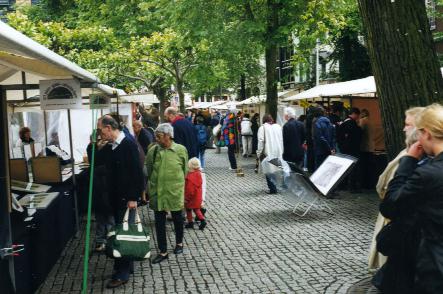
spui
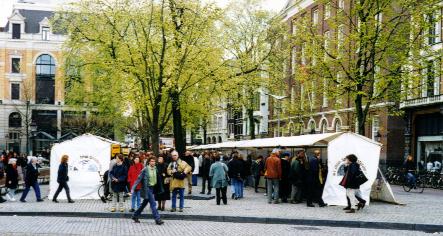
spui

Tuesday, December 07, 2004
Lamu (part 2)
---------------------------------------------------------------------------------
We reached Makowe, the final stop on main land, late in the afternoon. From here a ferry would take us to the Lamu island. The island is not very far- at the most about 3 kms into the sea - but the town of Lamu is on one side of the island and it is a 6 km ferry ride. Since the buses came in a convoy, the ferry had to make multiple trips to transfer the crowd to Lamu. So that fewer trips could be made, more passengers than what was safe, were taken inside the boat.
Kieron and I thought it is best to be at the edge of the ferry since one can jump out easily lest the ferry sinks. So we pushed ouselves closer to the edge, where a wooden bench ran all along the ferry. I could get a place to sit but Kieron couldnt. He, however, found a pole to lean on. In a short while the whole ferry was filled with people. Most of the women were wearing brightly coloured kangas and kikois . K and K are batik printed fabric that women wear. These are usually sold in pairs: one for wearing and the other to carry a baby on the back. Kangas have a swahili proverb printed on it and is usually made up of a thinner fabric. As Lamu is predominanty Islamic, few women were also wearing Bui Bui (Burkha). Some of the people in the ferry were of african/arab descent, indicative of the rich trading past these areas had with Arabia.
Once the ferry was deemed full, loud shouts were exchanged between various 'crew' on board and on the land. Ropes were thrown into the ferry and slowly the it edged into the water with the engine groaning to break the inertia. My eyes then fell on a wooden box in the middle of the ferry; I presumed this to be a cover for a part of the motor, so that either the hot or the moving parts would not get into contact with the commuters. However, hone by thousands of years of survival instincts, my brain quickly replaced these thoughts by thoughts of my swimming capability. Alarmingly, I realised that after the boat travels for about 15 meters, the shore is certainly out of my swimming reach and so quickly tried to recall the back float lesson, that would enable me to float till help arrives.
With my mind completely filled with harrowing thoughts of drowning, I did not notice the scenery around until i could see the 'skyline' of the town of Lamu. As the image of the town started getting larger, Kieron and I gave a sigh of relief and understanding glances that kind of indicated, we made it! Just as our understanding glances were giving way to understanding smiles, the wooden box that was to protect the commuters from getting burnt, started to emanate smoke. I guess, it must have taken a long time for it to get to this stage but no one noticed until thick smoke started to come from it. With some quick shouts, the engine was quickly shut off and the box was taken out and the fire was douced. However, the then engine refused to start again. Just refused. All this happened when the ferry was within 200 meters to the jetty. The island is a bit rectangular in shape and the town is along one of the smaller sides of it. So for the last 100 meters or so, we were moving parallel to the edge of the town and island. All along the edge were cement cubes that was used to protect the edge from getting eroded into the sea. Just after the cement cubes was the main lane of the town.
The main lane was now filling up with people. I saw a small bunch of chaps pointing out to people in the boat, saying something and giving each other friendly slaps. I thought they must be wagering bets as to who would make it to the shore and who wouldnt after the ferry sinks. After a short while attempts to start the engine were given up and with some loud shouts, help was sought to tug us to the jetty. These shouts yielded help in form of a small motorised boat that brought us to the land.
The jetty was filled with beach boys 'hunting' for the tourists. Since Kieron spoke swahili and since most people in Kenya assumed I was a resident, we werent troubled too much.
The beach front of the town had some shacks which I assumed to be hanging spots for the tourists and many quaint swahili houses with large carved wooden doors. The number of donkeys on the streets is too large to be normal. Later on I came to know that Lamu has only three motorised vehicles. So the alternate means of transport to walking are either cycles or donkeys (as our old school books say: beasts of burden). Itseems that Lamu even has a home for the aged donkeys.
The first spot we went to was Hotel Hapa Hapa: an open fronted shack that had plastic chairs and tables. We went in, plonked ourselves in the chairs on the same side of the table to see the sea as we sipped our juices....
[more about the charming town of Lamu in the next part]
We reached Makowe, the final stop on main land, late in the afternoon. From here a ferry would take us to the Lamu island. The island is not very far- at the most about 3 kms into the sea - but the town of Lamu is on one side of the island and it is a 6 km ferry ride. Since the buses came in a convoy, the ferry had to make multiple trips to transfer the crowd to Lamu. So that fewer trips could be made, more passengers than what was safe, were taken inside the boat.
Kieron and I thought it is best to be at the edge of the ferry since one can jump out easily lest the ferry sinks. So we pushed ouselves closer to the edge, where a wooden bench ran all along the ferry. I could get a place to sit but Kieron couldnt. He, however, found a pole to lean on. In a short while the whole ferry was filled with people. Most of the women were wearing brightly coloured kangas and kikois . K and K are batik printed fabric that women wear. These are usually sold in pairs: one for wearing and the other to carry a baby on the back. Kangas have a swahili proverb printed on it and is usually made up of a thinner fabric. As Lamu is predominanty Islamic, few women were also wearing Bui Bui (Burkha). Some of the people in the ferry were of african/arab descent, indicative of the rich trading past these areas had with Arabia.
Once the ferry was deemed full, loud shouts were exchanged between various 'crew' on board and on the land. Ropes were thrown into the ferry and slowly the it edged into the water with the engine groaning to break the inertia. My eyes then fell on a wooden box in the middle of the ferry; I presumed this to be a cover for a part of the motor, so that either the hot or the moving parts would not get into contact with the commuters. However, hone by thousands of years of survival instincts, my brain quickly replaced these thoughts by thoughts of my swimming capability. Alarmingly, I realised that after the boat travels for about 15 meters, the shore is certainly out of my swimming reach and so quickly tried to recall the back float lesson, that would enable me to float till help arrives.
With my mind completely filled with harrowing thoughts of drowning, I did not notice the scenery around until i could see the 'skyline' of the town of Lamu. As the image of the town started getting larger, Kieron and I gave a sigh of relief and understanding glances that kind of indicated, we made it! Just as our understanding glances were giving way to understanding smiles, the wooden box that was to protect the commuters from getting burnt, started to emanate smoke. I guess, it must have taken a long time for it to get to this stage but no one noticed until thick smoke started to come from it. With some quick shouts, the engine was quickly shut off and the box was taken out and the fire was douced. However, the then engine refused to start again. Just refused. All this happened when the ferry was within 200 meters to the jetty. The island is a bit rectangular in shape and the town is along one of the smaller sides of it. So for the last 100 meters or so, we were moving parallel to the edge of the town and island. All along the edge were cement cubes that was used to protect the edge from getting eroded into the sea. Just after the cement cubes was the main lane of the town.
The main lane was now filling up with people. I saw a small bunch of chaps pointing out to people in the boat, saying something and giving each other friendly slaps. I thought they must be wagering bets as to who would make it to the shore and who wouldnt after the ferry sinks. After a short while attempts to start the engine were given up and with some loud shouts, help was sought to tug us to the jetty. These shouts yielded help in form of a small motorised boat that brought us to the land.
The jetty was filled with beach boys 'hunting' for the tourists. Since Kieron spoke swahili and since most people in Kenya assumed I was a resident, we werent troubled too much.
The beach front of the town had some shacks which I assumed to be hanging spots for the tourists and many quaint swahili houses with large carved wooden doors. The number of donkeys on the streets is too large to be normal. Later on I came to know that Lamu has only three motorised vehicles. So the alternate means of transport to walking are either cycles or donkeys (as our old school books say: beasts of burden). Itseems that Lamu even has a home for the aged donkeys.
The first spot we went to was Hotel Hapa Hapa: an open fronted shack that had plastic chairs and tables. We went in, plonked ourselves in the chairs on the same side of the table to see the sea as we sipped our juices....
[more about the charming town of Lamu in the next part]
Thursday, November 04, 2004
In the land of "hakuna matata"
With the talk of the sea few days ago, I was reminded of my lone trip on the sea. I made a three day dhow trip visiting few islands around Lamu. Lamu is a small island off the Kenyan coast close to Somali border. Before I start with the blog, some admin issues: I would do this writing in part. The first part will be about getting to Lamu, the second one will be about Lamu itself and the third one will be about the sea trip. (so long way off before you could get to my sea story). Atleast that's the plan as things stand now. (Anyway, before you start reading let me warn you, this first part is long, real long. Now that it has turned out like this, I will shorten the other two)
I was in Nairobi researching for my Masters thesis and for a while, I was not distracted by the touristy attraction all around. I had too many things to do. Doing research on a shoe string budget in a foreign county with the institute that was to play the host going bankrupt was not easy. This non touristy nature was also due to other reasons. First, I did not have the money to go on a safari (the cheapest was US$ 80 a night and this was “peel your own potatoes and make your own bed” kind of deal and the most expensive was US 250/hour of safari-ing on a hot air balloon; included within this price was a glass of champagne after the ‘tiring’ ride over animals). I also felt guilty going ga-ga over wild life there when I did not visit a single national park in India. Alternatively, I could have had a good time visiting nice urban watering holes but I too scared to move around in the night on the streets of Nairobi. However, this non tourist status existed until I met Kieron.
I was at one of the seminars being conducted by ILO on the 'informal sector'. Informal sector, is a single term that represents all the tiny manufacturing and servicing activities that one mostly get to see in the slum in urban areas all over lesser developed countries. I did not know of this ‘informal sector’ studies until I went to Kenya. Anyway, Kieron is from the Royal College of Design in London and is Irish (so did not tower over me). Since the attendance to the seminar was less than what ILO expected which in turn meant that the budget was in excess of the expenses. The bloke who was in charge of this meet, an Englishman, was a sport and allowed the booze to flow. This gave opportunity for many of us to interact with one and another. Since I was on a 'passion fruit juice' trip then, I was ordering fresh juice. I could buy booze anywhere but sipping fresh fruit juice in a star hotel is something I cannot afford. Another reason why I did not drinking was that I did not want to display my poor alcohol holding capacity especially on a near empty stomach. In hindsight this was a good decision for those professional could really drink.
It was in this seminar that I met Kieron, he was experimenting on cheap communication systems to disseminate innovative designs to metal workers. We got talking and then he was shocked that I was in Nairobi for over 5 weeks and have never been anyplace except to the Indian restaurant close to River Road, YMCA close to Uhuru park, and to the Iskon temple in Ngara (where free desi food was given every sunday including ghee filled sweet dish).
So few days later he was at my workplace in Westlands. Ngara and Westlands are filled with Indians. Westland with the ultra-rich and Ngara with middle-class (I was staying as a paying guest in Ngara). He had a small piki-piki (motor cycle) this meant that I could visit many interesting places around the city. (It was in one interesting place that a woman friend of Kieron had asked me out. Actually he only time in my entire existence until now, a woman asked me if we could meet. Heck I was married. So for a moment I was sad for myself. Actually for a long moment)
Since Christmas was not far away, Kieron asked me if I wanted to go out of Nairobi. I sure was. He said we could go to Lamu. Lamu is a small island close to Somalia. It was between Lamu, Mombasa and Zanzibar that the Swahili culture was born. Since I could not afford the airticket, Kieron said that we could take the night bus to Mombasa, spend a few hours, take another bus to Malindi and stop for that night. Next day we could take another bus that will take us to the point from where the ferry would take us to Lamu. However, there have been some cases of Somali gun men stopping the buses to Lamu and looting them but these days, the buses move in a convoy and each one would carry a gunman. As it sounded exciting, I was all game for it.
I did not remember much of the night bus to Mombasa except that we stopped somewhere to eat and drink some tea. We arrived in Mombasa at dawn and many men were returning from the mosque. Kieron was all excited since at this time of the day, around the local cafes, one can find old women selling spicy chick peas with coconut and can be eaten with a ‘cripy puri like bread’. This, he said, is very special and is only available at this time of the day. It was something not too different from our chat but then it was different and very nice. Perhaps it is the time and place that made the significant difference to the taste. So we had this kenyan variation of puri-channa for breakfast. and soon headed for Malindi. Mombasa has fort Jesus built by Portuguese, a nice old harbour and some lovely bazaars but we decided to do a bit of sight seeing on our way back.
Malindi, Kieron told me was the hide-out for the mafia. So in middle of know where, one can find huge hotels, bars and other such interesting places where the mafia would like to cool their heels. (Folks, Mombasa also featured in the movie 'Company'. Maybe Malindi-Mombasa is the area where goons from all over the world sip booze in coconuts and put up their feet for a while). Malinidi is also the place from where Vasco da gama was given a guide, who then helped him navigate to India. First thing we did after reaching Malindi was to shower and crash. We were too tired. Woke up hungry in the afternoon to the calls of the meuzzin. We then went out into the town to eat. I remember Malindi to be a hot and dusty place. We found a nice cool place near the market next to the bus stop. ‘Found’ because I was looking for a place that served passion fruit juice.
We went back and slept until the evening. Then went around looked some trinket shops and went to the beach where a memorial for Vasco da Gama was built. For dinner we went to this huge Indian restaurant where we two were the only customers. Maybe the actual ‘customers’ arrive latter in the night. The owners were out in the front porch and did not even say hello to me. They sure must be in cahoots with the Mafioso.
Next morning took our bus that took us to Lamu as we ate brightly coloured (with carcinogenic colour for sure) boabad seeds and gaped at the alien landscape with Baobab tree that looked as if they are growing upside down and twin headed palm tree and fields of sharp sisal hemp.
End of part I
I was in Nairobi researching for my Masters thesis and for a while, I was not distracted by the touristy attraction all around. I had too many things to do. Doing research on a shoe string budget in a foreign county with the institute that was to play the host going bankrupt was not easy. This non touristy nature was also due to other reasons. First, I did not have the money to go on a safari (the cheapest was US$ 80 a night and this was “peel your own potatoes and make your own bed” kind of deal and the most expensive was US 250/hour of safari-ing on a hot air balloon; included within this price was a glass of champagne after the ‘tiring’ ride over animals). I also felt guilty going ga-ga over wild life there when I did not visit a single national park in India. Alternatively, I could have had a good time visiting nice urban watering holes but I too scared to move around in the night on the streets of Nairobi. However, this non tourist status existed until I met Kieron.
I was at one of the seminars being conducted by ILO on the 'informal sector'. Informal sector, is a single term that represents all the tiny manufacturing and servicing activities that one mostly get to see in the slum in urban areas all over lesser developed countries. I did not know of this ‘informal sector’ studies until I went to Kenya. Anyway, Kieron is from the Royal College of Design in London and is Irish (so did not tower over me). Since the attendance to the seminar was less than what ILO expected which in turn meant that the budget was in excess of the expenses. The bloke who was in charge of this meet, an Englishman, was a sport and allowed the booze to flow. This gave opportunity for many of us to interact with one and another. Since I was on a 'passion fruit juice' trip then, I was ordering fresh juice. I could buy booze anywhere but sipping fresh fruit juice in a star hotel is something I cannot afford. Another reason why I did not drinking was that I did not want to display my poor alcohol holding capacity especially on a near empty stomach. In hindsight this was a good decision for those professional could really drink.
It was in this seminar that I met Kieron, he was experimenting on cheap communication systems to disseminate innovative designs to metal workers. We got talking and then he was shocked that I was in Nairobi for over 5 weeks and have never been anyplace except to the Indian restaurant close to River Road, YMCA close to Uhuru park, and to the Iskon temple in Ngara (where free desi food was given every sunday including ghee filled sweet dish).
So few days later he was at my workplace in Westlands. Ngara and Westlands are filled with Indians. Westland with the ultra-rich and Ngara with middle-class (I was staying as a paying guest in Ngara). He had a small piki-piki (motor cycle) this meant that I could visit many interesting places around the city. (It was in one interesting place that a woman friend of Kieron had asked me out. Actually he only time in my entire existence until now, a woman asked me if we could meet. Heck I was married. So for a moment I was sad for myself. Actually for a long moment)
Since Christmas was not far away, Kieron asked me if I wanted to go out of Nairobi. I sure was. He said we could go to Lamu. Lamu is a small island close to Somalia. It was between Lamu, Mombasa and Zanzibar that the Swahili culture was born. Since I could not afford the airticket, Kieron said that we could take the night bus to Mombasa, spend a few hours, take another bus to Malindi and stop for that night. Next day we could take another bus that will take us to the point from where the ferry would take us to Lamu. However, there have been some cases of Somali gun men stopping the buses to Lamu and looting them but these days, the buses move in a convoy and each one would carry a gunman. As it sounded exciting, I was all game for it.
I did not remember much of the night bus to Mombasa except that we stopped somewhere to eat and drink some tea. We arrived in Mombasa at dawn and many men were returning from the mosque. Kieron was all excited since at this time of the day, around the local cafes, one can find old women selling spicy chick peas with coconut and can be eaten with a ‘cripy puri like bread’. This, he said, is very special and is only available at this time of the day. It was something not too different from our chat but then it was different and very nice. Perhaps it is the time and place that made the significant difference to the taste. So we had this kenyan variation of puri-channa for breakfast. and soon headed for Malindi. Mombasa has fort Jesus built by Portuguese, a nice old harbour and some lovely bazaars but we decided to do a bit of sight seeing on our way back.
Malindi, Kieron told me was the hide-out for the mafia. So in middle of know where, one can find huge hotels, bars and other such interesting places where the mafia would like to cool their heels. (Folks, Mombasa also featured in the movie 'Company'. Maybe Malindi-Mombasa is the area where goons from all over the world sip booze in coconuts and put up their feet for a while). Malinidi is also the place from where Vasco da gama was given a guide, who then helped him navigate to India. First thing we did after reaching Malindi was to shower and crash. We were too tired. Woke up hungry in the afternoon to the calls of the meuzzin. We then went out into the town to eat. I remember Malindi to be a hot and dusty place. We found a nice cool place near the market next to the bus stop. ‘Found’ because I was looking for a place that served passion fruit juice.
We went back and slept until the evening. Then went around looked some trinket shops and went to the beach where a memorial for Vasco da Gama was built. For dinner we went to this huge Indian restaurant where we two were the only customers. Maybe the actual ‘customers’ arrive latter in the night. The owners were out in the front porch and did not even say hello to me. They sure must be in cahoots with the Mafioso.
Next morning took our bus that took us to Lamu as we ate brightly coloured (with carcinogenic colour for sure) boabad seeds and gaped at the alien landscape with Baobab tree that looked as if they are growing upside down and twin headed palm tree and fields of sharp sisal hemp.
End of part I
Wednesday, October 27, 2004
A Random rant on myself, my travels and some travelogues
I have always been interested in travel. Travel not to get into (or get some) kodak moments but to look around, meet people, understand how the life on the other side of the mountain organises itself and expand my horizons of wonder. I did not own a camera or click a single snap in the first four countries I visited. One of these four includes Switzerland. I have three photos in Zurich and two photos in St.Gallen, for they were group photos. Then I thought that was macho but now I realise that was stupid. So, these days, I do indulge in Kodak moments and enjoy taking pictures. Digital life is so easy. However I have only two pictures of myself here in Amsterdam! Not macho but too shy to ask people to take my picture. What will I do with pictures of myself, a not-so-tall (how can I call myself short?), grey-haired, double-chinned man with a tiny potbelly!
Though not bestowed with a head turning charima or jaw droping intelligence, I have, however been fortunate with my travels thus far. Fortunate because I have been to 14 countries with a minimum stay of a day and a maximum stay of 27 months, not counting the day spent at a illegal immigrant's detention centre in Rome Airport for entering the country without a transit visa. Fortunate because I did not pay for most of this travel. Fortunate because I neighter had a high flying job or a software job that makes it more or less mandatory to travel overseas these days. Fortunate because I did most of this travel while still pursuing my academics. Now you would understand why I am still on the student side of the univ, while I am about to complete 36 years of existence!!! Now you know why my bank balance is still not even a lakh of rupees even after having 9 years of work experience!! Heck I am more or less happy and thats what counts though I have to confess I am trifle sad with my bank balance.
My urge to travel, of late, has been increasing and so is my craving to fill myself up with the experiences of other travellers. Since I dont have much time to travel, I am indulging on the latter. In the last six months I have purchased 33 travelogues. I have read four thus far. Havent been able to complete four others (two Paul Theroux's, one Somerset Maugham and one Eric Newby). The rest is for the near future.
I have not been able to finish Paul Theroux coz I find him to be too obnoxious, condesending and gloomy (SSM, you may disagree but I will tell you why in one of my subsequents blogs). Eric newby since it is at the bottom of the pile (also because it is about his trip through USSR on a trans siberian train and he got permission to get out only at few stops en route. So how exciting can the trip be? Although he has done a good job). Maugham coz I want to savour every sentence he writes. Until I get my hands onto another account of his trips, I will continue to read a few lines of his book describing his travels (mostly over rivers) from Rangoon to Haipong through Bangkok, Phnom Phen and Saigon. Maugham, like R.K.Narayan constructs simple sentences, does not use very difficult words but manage to convey deep meanings. Boy, I will never ever tire of these two authors. As Narayan writes, there are two kinds of authors: those whome you can read and those whom you cannot. Authors I cannot read are Arundati Roy (her language was too flowery), Robert Prisig (sorry Asuph, he is too heavy for me)
Coming back to the four travelogues that I read, these are John Steinbeck's Travel with Charlie (actually re-read), Shiva Naipaul's North of South, Norman Lewis's Voices of the Old Sea and Redmond O'Hanlon's In Touble Again.
Steinbeck's book is a classic. Look at the start! I am going to keying in every single word of it since I just love the start. Many of you may have read this book but I will still key in the start. It is worth reading it again. :)
When I was very young and the urge to be someplace else was on me. I was assured by mature people that maturity would cure this itch. When years described me as mature, the remedy prescribed was middle age. In middle age I was assured that greater age would calm my fever and now that I am fifty-eight perhaps senility will do the job. Nothing has worked. Four hoarse blasts of a ship's whistle still raise the hair on my neck and set my feet to tapping. The sound of a jet, an engine warming up, even the clopping of shod hooves on pavement brings on the ancient shudder, the dry mouth and vacant eye, the hot palms and the churn of stomach high up under the rib cage. In other words, I don't improve; in further words, once a bum always a bum. I fear the disease is incurable. I set this matter down not to instruct others but to inform myself
With this kind of a start the book can only get better and it does. He was already famous by the time he made this trip across America on a custom made truck that carried a cabin like small house. Though many people adviced against the trip that he would be recognised, he says that over 10,000 miles through 34 states he was not recognised even once. Since his "old french gentleman poodle" named Charlie was his sole companion through the journey, hence the name of the book. The book is never boring, never funny and never thrilling. It is a contemplative narration of an extremly thoughtful man in extremely simple language. Those tiny few of you who have not read this book, I would certainly recommend it.
I have already reviewed Shiva Naipaul's North of South
The rest of the two books am going to review in my next blog. A proper review not a random rant.
Though not bestowed with a head turning charima or jaw droping intelligence, I have, however been fortunate with my travels thus far. Fortunate because I have been to 14 countries with a minimum stay of a day and a maximum stay of 27 months, not counting the day spent at a illegal immigrant's detention centre in Rome Airport for entering the country without a transit visa. Fortunate because I did not pay for most of this travel. Fortunate because I neighter had a high flying job or a software job that makes it more or less mandatory to travel overseas these days. Fortunate because I did most of this travel while still pursuing my academics. Now you would understand why I am still on the student side of the univ, while I am about to complete 36 years of existence!!! Now you know why my bank balance is still not even a lakh of rupees even after having 9 years of work experience!! Heck I am more or less happy and thats what counts though I have to confess I am trifle sad with my bank balance.
My urge to travel, of late, has been increasing and so is my craving to fill myself up with the experiences of other travellers. Since I dont have much time to travel, I am indulging on the latter. In the last six months I have purchased 33 travelogues. I have read four thus far. Havent been able to complete four others (two Paul Theroux's, one Somerset Maugham and one Eric Newby). The rest is for the near future.
I have not been able to finish Paul Theroux coz I find him to be too obnoxious, condesending and gloomy (SSM, you may disagree but I will tell you why in one of my subsequents blogs). Eric newby since it is at the bottom of the pile (also because it is about his trip through USSR on a trans siberian train and he got permission to get out only at few stops en route. So how exciting can the trip be? Although he has done a good job). Maugham coz I want to savour every sentence he writes. Until I get my hands onto another account of his trips, I will continue to read a few lines of his book describing his travels (mostly over rivers) from Rangoon to Haipong through Bangkok, Phnom Phen and Saigon. Maugham, like R.K.Narayan constructs simple sentences, does not use very difficult words but manage to convey deep meanings. Boy, I will never ever tire of these two authors. As Narayan writes, there are two kinds of authors: those whome you can read and those whom you cannot. Authors I cannot read are Arundati Roy (her language was too flowery), Robert Prisig (sorry Asuph, he is too heavy for me)
Coming back to the four travelogues that I read, these are John Steinbeck's Travel with Charlie (actually re-read), Shiva Naipaul's North of South, Norman Lewis's Voices of the Old Sea and Redmond O'Hanlon's In Touble Again.
Steinbeck's book is a classic. Look at the start! I am going to keying in every single word of it since I just love the start. Many of you may have read this book but I will still key in the start. It is worth reading it again. :)
When I was very young and the urge to be someplace else was on me. I was assured by mature people that maturity would cure this itch. When years described me as mature, the remedy prescribed was middle age. In middle age I was assured that greater age would calm my fever and now that I am fifty-eight perhaps senility will do the job. Nothing has worked. Four hoarse blasts of a ship's whistle still raise the hair on my neck and set my feet to tapping. The sound of a jet, an engine warming up, even the clopping of shod hooves on pavement brings on the ancient shudder, the dry mouth and vacant eye, the hot palms and the churn of stomach high up under the rib cage. In other words, I don't improve; in further words, once a bum always a bum. I fear the disease is incurable. I set this matter down not to instruct others but to inform myself
With this kind of a start the book can only get better and it does. He was already famous by the time he made this trip across America on a custom made truck that carried a cabin like small house. Though many people adviced against the trip that he would be recognised, he says that over 10,000 miles through 34 states he was not recognised even once. Since his "old french gentleman poodle" named Charlie was his sole companion through the journey, hence the name of the book. The book is never boring, never funny and never thrilling. It is a contemplative narration of an extremly thoughtful man in extremely simple language. Those tiny few of you who have not read this book, I would certainly recommend it.
I have already reviewed Shiva Naipaul's North of South
The rest of the two books am going to review in my next blog. A proper review not a random rant.
Tuesday, October 26, 2004
Public squares in Amsterdam
it is exciting to be in a land so far from home. however, running through the heart as a tiny stream is the loneliness of being away from home. sometime this tiny stream can become a bit too much to handle. however, such times are few and far between.
i like being around people. where ever i am. i do like to visit parks and other beautiful places but then it is quite rare. i would like to sit in a square with people walking all around me. i seek solace in the fact that there is humanity around and it never lets me down.
for instance the best place to sit and watch humanity go by is the dam square in amsterdam. it is one of the most important landmarks in the city centre. with nice buildings around it. there are tourists milling around all the time.
amsterdam centre is for the tourists. americans in great number. followed by japanese and then there are some from rest of the world. american, perhaps, come more to smoke legal joints. and in between the joints go out to see the museums. including the privately run sex museum.
coming back to the dam square, there are always some event taking place. sometimes there is music being played. another time a juggler was having a great show. yet another time there was a stage with some jazz music being played and on the stage were three young girls shaking their legs while singing the chorus. i quite like the youngest, barely in her teens, trying to swing. few weeks ago there was a huge religious book sale. representative of religious organisations of all kinds were selling thier books. the time when i pass by, the largest stall was the one selling satya sai baba's teaching. iskon also had a stall but nothing compared to one representing prashati nilayam. iskon, may have realised that religion, like fashion, moves in fads. perhaps iskon, feels that like fashion which is cyclic, their time may come again.
the only place to sit at the square is around the war memorial or on the steps of the palace. both are not the best places to be. there are always some wild and boisterous american youth group around the memorial. the steps of the palace is littered with food and drink packs. usually, some shaky hands spill large quantities of sticky drink that renders large part of the step unsuitable to sit. i should perhaps take my own chair and watch the people mill by.
last weekend, i woke up early and went to sit in another square called 'spui' (said spow). this is nice small place that has various kinds of markets. on friday it is second hand books, on sunday it is art. though there are lot of cafes around spui, it is quite noisy with trams going up and down. however, on the singel that runs perpendicular to spui and parallel to the canal, there are many nice cafes. i have been one called just '404', indicating the house number. it is a nice cafe that sells fruityogurt drinks. one can also find some german beers like warsteiner here. it is a nice small place and is quite frequented by the students of university of amsterdam.
two other popular squares are rembrantsplein and leidseplein. these two are completely filled with tourists right up to the brim. naturally, cafes here are all expensive. i never sat at any of the cafes here. though i do purchase icecream from 'australian' and watch some artist paint psychedelic painting that are snapped up by eager americans. perhaps to kind of help them remember the state their were mostly in, when they are back home.
around nieuw markt, where the red light area is, there are many cheap cafes. as one comes out of the metro one enters the Waag area. this is a small tower from where people were hanged, years ago. it was a place where freight from ships were weighed. some of the cafe here nice and also sells draught belguim beer: lefe, duvel, palm, etc. because of the prices and the area, it is frequented by students.
i still havent been to the jordaan area as yet. but then my stay in amsterdam hasnt come to an end yet.
i like being around people. where ever i am. i do like to visit parks and other beautiful places but then it is quite rare. i would like to sit in a square with people walking all around me. i seek solace in the fact that there is humanity around and it never lets me down.
for instance the best place to sit and watch humanity go by is the dam square in amsterdam. it is one of the most important landmarks in the city centre. with nice buildings around it. there are tourists milling around all the time.
amsterdam centre is for the tourists. americans in great number. followed by japanese and then there are some from rest of the world. american, perhaps, come more to smoke legal joints. and in between the joints go out to see the museums. including the privately run sex museum.
coming back to the dam square, there are always some event taking place. sometimes there is music being played. another time a juggler was having a great show. yet another time there was a stage with some jazz music being played and on the stage were three young girls shaking their legs while singing the chorus. i quite like the youngest, barely in her teens, trying to swing. few weeks ago there was a huge religious book sale. representative of religious organisations of all kinds were selling thier books. the time when i pass by, the largest stall was the one selling satya sai baba's teaching. iskon also had a stall but nothing compared to one representing prashati nilayam. iskon, may have realised that religion, like fashion, moves in fads. perhaps iskon, feels that like fashion which is cyclic, their time may come again.
the only place to sit at the square is around the war memorial or on the steps of the palace. both are not the best places to be. there are always some wild and boisterous american youth group around the memorial. the steps of the palace is littered with food and drink packs. usually, some shaky hands spill large quantities of sticky drink that renders large part of the step unsuitable to sit. i should perhaps take my own chair and watch the people mill by.
last weekend, i woke up early and went to sit in another square called 'spui' (said spow). this is nice small place that has various kinds of markets. on friday it is second hand books, on sunday it is art. though there are lot of cafes around spui, it is quite noisy with trams going up and down. however, on the singel that runs perpendicular to spui and parallel to the canal, there are many nice cafes. i have been one called just '404', indicating the house number. it is a nice cafe that sells fruityogurt drinks. one can also find some german beers like warsteiner here. it is a nice small place and is quite frequented by the students of university of amsterdam.
two other popular squares are rembrantsplein and leidseplein. these two are completely filled with tourists right up to the brim. naturally, cafes here are all expensive. i never sat at any of the cafes here. though i do purchase icecream from 'australian' and watch some artist paint psychedelic painting that are snapped up by eager americans. perhaps to kind of help them remember the state their were mostly in, when they are back home.
around nieuw markt, where the red light area is, there are many cheap cafes. as one comes out of the metro one enters the Waag area. this is a small tower from where people were hanged, years ago. it was a place where freight from ships were weighed. some of the cafe here nice and also sells draught belguim beer: lefe, duvel, palm, etc. because of the prices and the area, it is frequented by students.
i still havent been to the jordaan area as yet. but then my stay in amsterdam hasnt come to an end yet.
Monday, October 25, 2004
Review of the book "North of South"
I started to write a review of Shiva Naipaul's book this morning. First I have never written about a book that I have read. Second, the realisation that I should be writing my thesis chapters instead of blogs, was blocking my line of thoughts. So a unhealthy mix of these two reason made me decide that I should list out some books by few author and write a short reviews about them. Here goes my first one...
Shiva Naipaul was the younger brother of V.S.Naipaul. He was 16 year younger but died when he was 40.
The book North of South, is about his travel in Kenya, Tanzania and Zambia. Like any travel writer, he wrote of his experiences. However, unlike a normal travelogue , he filtered his experiences into two different sociological themes. One theme is the relationship between the Africans, Europeans and Asians. The other is about the experiences of common people.
At the time when SN was travelling, it was few years of independence for each of these countries. Each of them was in turn being subjected to the pet ideas of their leaders. Kenya was being subjected to Harambee (self help) concept of Jomo Kenyatta and Tanzania was being subjected to paternal socialism concept of Julius Nyerere. So, SN wanted to find out what the commers thought and felt about these ideas.
He also wanted to find out why the Africans hated Asians? Especially, when they did not harm Africans like Europeans did. They just ran shops and businesses. Whereas Europeans exploited the Africans in every possible manner but no African hates them (then). SN wanted to know why it was so.
While analysing these two themes, he does not use sociological/anthropological jargon. He does not analyse like an academician at all. Instead, he goes about like a normal person who wanted to find out why certain things are the way they are but unlike a normal person he uses simple words to explain the situation as well his answers very well.
In short this is a book that will interest readers interested in Africa/how commeners experience the pet concepts of their leaders/Indian diaspora.
I quite liked this book. In addition to the content, I also liked it for other reasons: it brought me back memories of my experiences in Kenya; it answered some of the questions that I had while I was experiences the country.
Some of his other books are Fireflies and Chipchip Gatherers. Where he wove stories among the Indian diaspora in Trinidad.
Shiva Naipaul was the younger brother of V.S.Naipaul. He was 16 year younger but died when he was 40.
The book North of South, is about his travel in Kenya, Tanzania and Zambia. Like any travel writer, he wrote of his experiences. However, unlike a normal travelogue , he filtered his experiences into two different sociological themes. One theme is the relationship between the Africans, Europeans and Asians. The other is about the experiences of common people.
At the time when SN was travelling, it was few years of independence for each of these countries. Each of them was in turn being subjected to the pet ideas of their leaders. Kenya was being subjected to Harambee (self help) concept of Jomo Kenyatta and Tanzania was being subjected to paternal socialism concept of Julius Nyerere. So, SN wanted to find out what the commers thought and felt about these ideas.
He also wanted to find out why the Africans hated Asians? Especially, when they did not harm Africans like Europeans did. They just ran shops and businesses. Whereas Europeans exploited the Africans in every possible manner but no African hates them (then). SN wanted to know why it was so.
While analysing these two themes, he does not use sociological/anthropological jargon. He does not analyse like an academician at all. Instead, he goes about like a normal person who wanted to find out why certain things are the way they are but unlike a normal person he uses simple words to explain the situation as well his answers very well.
In short this is a book that will interest readers interested in Africa/how commeners experience the pet concepts of their leaders/Indian diaspora.
I quite liked this book. In addition to the content, I also liked it for other reasons: it brought me back memories of my experiences in Kenya; it answered some of the questions that I had while I was experiences the country.
Some of his other books are Fireflies and Chipchip Gatherers. Where he wove stories among the Indian diaspora in Trinidad.
Historical fiction
These are some of the books that I have read. Instead of reviewing the books myself, I give links to reviews or to the publisher's sites.
Kiran Nagarkar wrote a book called Cuckold. The book is set in 16th century Mewar, Rajasthan. Meera Bai's unrelenting vow to remain celibate in her marriage as she considered only Lord Krishna as her lover/husband, is the core part of the book. The 'Cuckold' refers to the actual husband of Meera Bai. However, the book is also about the power struggle within the Mewar family and with the muslim rulers of Delhi. Here is a link to a Review of it
A book originally in Gujarati but translated into English called Master of Gujarat by K.K.Munshi. I quite liked this book. I purchased it without knowing that it is a classic in Gujarati. My friend later told me of this fact. The original one is called 'Gujarat no nath' (or something like that). Publisher's Link
Sunil Gangopadhaya wrote two books that are set in 19th century Calcutta. The first book starts after the first war of independence and is woven around people like Ishwar Chandra Vidyasagar, Micheal Madhusudan Dutt, etc. The second one has people from Rabindra Nath Tagore's family, Ramakrishna Paramhansa, Vivekananda, etc. The first one is called Those Days and second one is called First Light. I read the book First Light and quite liked it. These two books capture the golden age of Calcutta. Publisher's Link
Chikkaveera Rajendra is a book written by Masti Venkatesha Iyengar. This book is set in early 19th century Kodagu (Coorg). Rajendra was the last king whose power was taken over by the British in 1834. Review
Kiran Nagarkar wrote a book called Cuckold. The book is set in 16th century Mewar, Rajasthan. Meera Bai's unrelenting vow to remain celibate in her marriage as she considered only Lord Krishna as her lover/husband, is the core part of the book. The 'Cuckold' refers to the actual husband of Meera Bai. However, the book is also about the power struggle within the Mewar family and with the muslim rulers of Delhi. Here is a link to a Review of it
A book originally in Gujarati but translated into English called Master of Gujarat by K.K.Munshi. I quite liked this book. I purchased it without knowing that it is a classic in Gujarati. My friend later told me of this fact. The original one is called 'Gujarat no nath' (or something like that). Publisher's Link
Sunil Gangopadhaya wrote two books that are set in 19th century Calcutta. The first book starts after the first war of independence and is woven around people like Ishwar Chandra Vidyasagar, Micheal Madhusudan Dutt, etc. The second one has people from Rabindra Nath Tagore's family, Ramakrishna Paramhansa, Vivekananda, etc. The first one is called Those Days and second one is called First Light. I read the book First Light and quite liked it. These two books capture the golden age of Calcutta. Publisher's Link
Chikkaveera Rajendra is a book written by Masti Venkatesha Iyengar. This book is set in early 19th century Kodagu (Coorg). Rajendra was the last king whose power was taken over by the British in 1834. Review
Girl with a pearl earring etc.
It was after reading Girl with a Pearl Earring, that my interest in Vermeer was rekindled. Many years ago, at Rijksmuseum in Amsterdam, I purchased a poster of the 'Little Street'. Somehow, the picture was so real that it almost seemed like a photograph. I was also attracted to LS due to that common architecture of Europe it depicts.
In LS, Vermeer depicts two houses, each shown partially. Running between these two houses and onto the street and perhaps into the canal, is a tiny drain. The two building, one of which is larger than the other, has a small passage between them. In the passage there is a woman bending over a broom. At the entrance of the next building sits a woman doing needle work. On the street in front of these two house and between these two houses sits a woman/child playing with another one, who is underneath a platform. In the painting, the facades of few buildings behind these houses can be seen. All the buildings are made out of exposed brick and hence are red in colour. However, the lower parts of the first two buildings are painted white, until the height a man could reach. The top edges of the white wash are irregular perhaps because one had to be on the toe to reach out to this height. Between these buildings is the typical dutch sky - patches of blue between white clouds. One gets to see these kinds of buildings at many common places in Europe, especially in the low income areas. The gables of the houses, tapering in steps instead of a straight line. This poster of LS has been languishing as a roll in some corner of our home. In the light of my new Vermeer interest, I should perhaps do something about it. Here is a picture of LS
Girl with a pearl earring , as a book was quite fascinating. The author Tracy Chevaliers took perhaps the most simple of Vermeers painting and wove, between facts of Vermeers life, a lovely story around it. Perhaps it is the most intriguing of all his painting that survived. Which incidentally are only 35 plus a recent find. When I saw the painting it was not at all that impressive. There were hardly any details on it. Actually, I peered hard to see that lock of hair which the author have given quite some significance to. In the book, the girl due to difficulties at home, is working as a maid in Vermeers house. Unlike his wife, she is extremely fascinated by his 'ways of seeing' and has a feel for the way Vermeer depicts his subjects. There is an attraction and respect between these two souls. V gives the task of mixing colour to her. A task that he has never entrusted anyone with. Soon, he wants to paint her with a large pearl earring of his wife. Without the wife's knowledge. All along the girl has her hair covered in white cloth but for this painting, he gives her some coloured cloth. As she was trying these head covers, he bursts into her corner of living to see her hair. The book says that, he then paints a tiny lock sticking out from the the blue and yellow headgear. So I peered hard at the painting to look for that lock of hair. Couldnt find it. I went very close to the painting only to have the security around me!
The other significant aspect of this painting is the pout. The book says that the girl has been asked to look over her left shoulder and part her lips. Kind of indicating her latent feeling of giving a 'wanting look' at the artist.
However, the electronic museum guide that was given free of charge tells me, that this 'girl' is a fictional character. No such person existed. It was quite frequent for artisits in those days to paints objects of interests from the mind without having any living models in the front of them. I even knew the french term for it, only for a second though. The book I think captures lot more from the painting than the actual painting itself.
What facinated me more was Vermeer's depiction of Delfts, called 'The View of Delfts' . In the museum, this paintin hangs right in the front of GwPE. Vermeer lived in Delfts. In days before Vermeer, Rotterdam was actually called Delft's Haven - harbour of Delfts. For many years, Delfts was the capital city of this area. The actual painting is much more interesting that what one sees in pictures. This painting depticts the view of the city as he sits from the other side of the river. In the foreground are few people and a boat. Because of the distance from the city, the sky forms a large part of the painting. The city is shown with the Rotterdam gate on the right side of the painting. One can also see the canals going into the city from the river. What is facsinating is that right over the front part of the depicted city is a cloud that block the sunlight. However, the city shown behind is still lit by the sun. So when on stands in front of the painting though the front part is well depicted with details, it is the well lit hinterground, devoid of any details that strikes the eye.
It is at times like this, in front of interesting paintings, that I wish I studied art history. I did not know such a faculty existed until I came to Europe in my mid twenties. Art history, in a way, also deals with sociology, architecture, psychology, and other aspects of human lifes that sensitive eys froze for us to feel and relive what they saw in their minds-eye. Sure, the reality is moulded into a figment of imagination by the artist. That, I think is the interesting part. Weaving a story around the forces that made the artist depict the reality in a way he see it. For me, no one seem to have done it as well as Tracy Chevaliars in her book. She took a tiny painting, which in fact was not even a reality and wove a good story around it. It certainly is a nice way of getting introduced to art. Those who have not read it and those who are interested in the seventeeth century life or art, should read it. I wonder how the movie was?
In LS, Vermeer depicts two houses, each shown partially. Running between these two houses and onto the street and perhaps into the canal, is a tiny drain. The two building, one of which is larger than the other, has a small passage between them. In the passage there is a woman bending over a broom. At the entrance of the next building sits a woman doing needle work. On the street in front of these two house and between these two houses sits a woman/child playing with another one, who is underneath a platform. In the painting, the facades of few buildings behind these houses can be seen. All the buildings are made out of exposed brick and hence are red in colour. However, the lower parts of the first two buildings are painted white, until the height a man could reach. The top edges of the white wash are irregular perhaps because one had to be on the toe to reach out to this height. Between these buildings is the typical dutch sky - patches of blue between white clouds. One gets to see these kinds of buildings at many common places in Europe, especially in the low income areas. The gables of the houses, tapering in steps instead of a straight line. This poster of LS has been languishing as a roll in some corner of our home. In the light of my new Vermeer interest, I should perhaps do something about it. Here is a picture of LS
Girl with a pearl earring , as a book was quite fascinating. The author Tracy Chevaliers took perhaps the most simple of Vermeers painting and wove, between facts of Vermeers life, a lovely story around it. Perhaps it is the most intriguing of all his painting that survived. Which incidentally are only 35 plus a recent find. When I saw the painting it was not at all that impressive. There were hardly any details on it. Actually, I peered hard to see that lock of hair which the author have given quite some significance to. In the book, the girl due to difficulties at home, is working as a maid in Vermeers house. Unlike his wife, she is extremely fascinated by his 'ways of seeing' and has a feel for the way Vermeer depicts his subjects. There is an attraction and respect between these two souls. V gives the task of mixing colour to her. A task that he has never entrusted anyone with. Soon, he wants to paint her with a large pearl earring of his wife. Without the wife's knowledge. All along the girl has her hair covered in white cloth but for this painting, he gives her some coloured cloth. As she was trying these head covers, he bursts into her corner of living to see her hair. The book says that, he then paints a tiny lock sticking out from the the blue and yellow headgear. So I peered hard at the painting to look for that lock of hair. Couldnt find it. I went very close to the painting only to have the security around me!
The other significant aspect of this painting is the pout. The book says that the girl has been asked to look over her left shoulder and part her lips. Kind of indicating her latent feeling of giving a 'wanting look' at the artist.
However, the electronic museum guide that was given free of charge tells me, that this 'girl' is a fictional character. No such person existed. It was quite frequent for artisits in those days to paints objects of interests from the mind without having any living models in the front of them. I even knew the french term for it, only for a second though. The book I think captures lot more from the painting than the actual painting itself.
What facinated me more was Vermeer's depiction of Delfts, called 'The View of Delfts' . In the museum, this paintin hangs right in the front of GwPE. Vermeer lived in Delfts. In days before Vermeer, Rotterdam was actually called Delft's Haven - harbour of Delfts. For many years, Delfts was the capital city of this area. The actual painting is much more interesting that what one sees in pictures. This painting depticts the view of the city as he sits from the other side of the river. In the foreground are few people and a boat. Because of the distance from the city, the sky forms a large part of the painting. The city is shown with the Rotterdam gate on the right side of the painting. One can also see the canals going into the city from the river. What is facsinating is that right over the front part of the depicted city is a cloud that block the sunlight. However, the city shown behind is still lit by the sun. So when on stands in front of the painting though the front part is well depicted with details, it is the well lit hinterground, devoid of any details that strikes the eye.
It is at times like this, in front of interesting paintings, that I wish I studied art history. I did not know such a faculty existed until I came to Europe in my mid twenties. Art history, in a way, also deals with sociology, architecture, psychology, and other aspects of human lifes that sensitive eys froze for us to feel and relive what they saw in their minds-eye. Sure, the reality is moulded into a figment of imagination by the artist. That, I think is the interesting part. Weaving a story around the forces that made the artist depict the reality in a way he see it. For me, no one seem to have done it as well as Tracy Chevaliars in her book. She took a tiny painting, which in fact was not even a reality and wove a good story around it. It certainly is a nice way of getting introduced to art. Those who have not read it and those who are interested in the seventeeth century life or art, should read it. I wonder how the movie was?
Subscribe to:
Posts (Atom)


